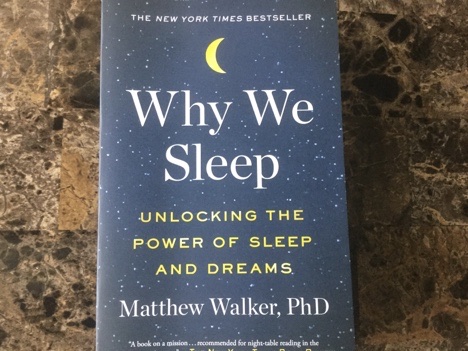
Accidents, addictions, ADHD, Alzheimer’s Disease, anxiety, cancer, depression, diabetes, heart attacks, infections, infertility, defective immune responses, manias, neuroses, obesity, psychoses, strokes. All of these are the result of, or exacerbated by, lack of sleep if you believe the convincing arguments presented by this very knowledgeable Berkeley sleep researcher in this his first book. With easily understood apt analogies and simple (perhaps over-simplified) schematics, he discusses our natural circadian rhymes and the brain controllers of wakefulness and somnolence. He documents, citing a huge number of studies, the dire individual, societal and global consequences of inadequate sleep quantity and quality and makes variably realistic recommendations for improving our sleep for all ages.
From the unnatural deleterious effects on teens of starting their schooling too early in the day and out of sync with their circadian clocks to the dramatically increased accident rates the day after switching to Daylight Saving Time, not all attributable to being late for work, and the dire consequences of medical trainees required to work unnaturally long shifts, his assertions are largely not disputable. Here in Ottawa the schools do the exact opposite of what would be optimal for learning, starting too late for preteens and far to early for teens. Unlike most social scientist researchers crusading for change, he seldom equates association with causation, and makes that distinction clear.
I have some concerns about this book although I accept the scientific logic and was greatly enlightened by the insights he imparts. Like many non-physician campaigners for changes in the health care educational system, he disparages the mainstream medical communities’ lack of knowledge about his particular specialty, an annoying insult to those who try their best to practice good medicine with an impossibly broad and ever increasing amount of information to absorb. He recommends that anyone with concerns about their sleep adequacy, which means just about everyone who reads his book, be assessed by a board-certified sleep specialist, a luxury available to at best a small minority of people even in the First World. Some of the assertions of links of illness to sleep deprivations seem weak, e.g. the connections between the gut biome and the brain centres involved with control of sleep. They may exist, but the old Scottish verdict of Guilt Not Proven would seem to apply. The enhancement of immune responses provided by sleep may be a two-edged sword given the increasing prevalence of autoimmune diseases and allergies. And while caffeine and alcohol are clearly absolute no-no’s for your sleep hygiene, there are some pleasures in life that are not worth sacrificing in exchange for an extra few years in diapers in a locked ward. I am not about to give up my morning caffeine jolt. His diatribes about almost all of our societal norms and institutions become a bit repetitive and annoying. And there is something cruel about blaming individuals’ illnesses on behaviour which is within societal norms.
I was disappointed that he does not even mention, let alone explain, the physiology behind that most delightful of all male human experiences with sleep, seemingly designed to frustrate women, namely the phenomenon of overwhelming postcoital somnolence.
This book is a great wake up call to address a grossly neglected healthcare and societal problem. I highly recommend reading at least parts of it. It does not have to be read from start to finish to be appreciated. Take some naps along the way.
Thanks, Andra.


