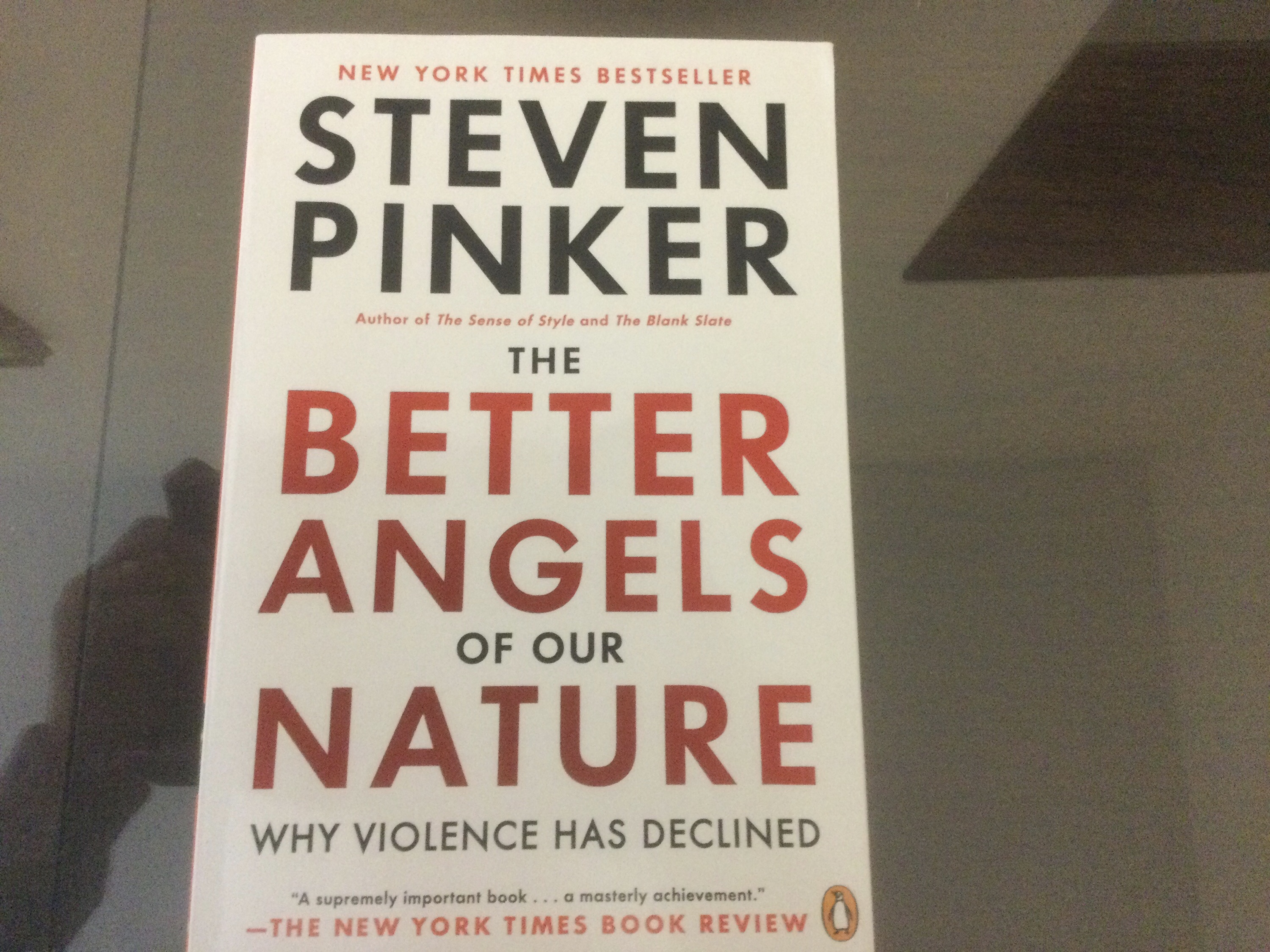
This thick volume starts off with a discussion of the rates and reasons for violence in our ancestors from the time of our divergence from other primates to Biblical times and then on to the Middle Ages, and the 20th century, including the prominent role that religious institutions and beliefs played in promoting violence and genocides. “Whether or not the Israelites actually engaged in genocide, they certainly thought it was a good idea.” The author is a Canadian-born atheist of Jewish background at Harvard.
The Humanitarian Revolution chapter veers a bit off course into long quotes from Voltaire, Samuel Johnson, Blaise Pascal, Denis Diderot, Shakespeare, Emanuel Kant, Thomas Payne, George Washington, Thomas Hobbes, John Locke, Adam Smith, Rene Descartes, Edmund Burke, Baruch Spinoza, and Charles Montesquieu in what seems to me to be an unnecessary effort to show off knowledge. But the conclusion that literacy, particularly the reading of novels, together with urbanization, led to abhorrence of previously sanctioned violence seems valid. Enlightenment humanism, (which I embrace as opposed to religious dogmatism), slowly evolved to emphasize our commonalities.
In trying to explain the (relatively) Long Peace following WWII, Pinker utilizes statistical modelling including Poisson distribution, power-law modelling and multiple logistic regression applied to the magnitude of wars. Statistical manipulation of derivatives of derivatives with arbitrary time frames seem at times to be designed to convince readers of a dubious conclusion. Nevertheless his conclusions that the rise of democracy, increasing international trade and organizations, urbanization, and education about other countries and peoples are potent anti-war weapons seem valid. The same statistical modelling of extensive data lead to the conclusion that civil wars, terrorism, and mass killing of political and ethnic groups (genocides), dependent on exclusionary ideologies have also dramatically declined in the last 40 years, contrary to what we usually hear from doom and gloom talking heads and politicians who oblige the terrorists by trying to scare us. In the long chapter documenting the rise of individual rights and the resultant decrease in rape, assault, domestic, child, and animal abuse, there is a superb snide discussion of the evil unanticipated consequences of efforts to ensure childhood safety.
The Inner Demons chapter is like thick molasses-far too heavy on neuroanatomy (and psychologists interpreting brain images) for most readers to digest or even wade through. And I am really tired of reading endless descriptions of experiments on social science undergrads paid beer money to participate in complicated and devious manipulations dreamed up by their professors. The division of reasons for evil into five arbitrary categories, and discussion of them is nevertheless interesting. But the fifteen pages devoted to Ideology is just an expansive documentation that peer pressure is powerful.
In The Better Angels, Pinker lays out several trends that go some way to explain why every parameter of life has, on average, never been better in the history of Homo sapiens, than at present.The Flynn effect documenting a world-wide increase in intelligence of average human beings was news to me. And the thirty-fold decrease in the risk of dying a violent death in the last millennium is striking.
After the book was written, Russia and Syria disproved his claim that no country would ever again use violence to change borders of a neighbouring one or deploy chemical weapons. And the Trump-era rise of white supremists has reversed the downward trend in racial violence documented for the previous half century. He could not have easily foreseen the rise of asymmetric warfare with drones that create moral dilemmas and inevitably will increase the temptation to start wars. Perhaps he addresses these in his 2018 Enlightenment Now that I have not read (nor am I likely to).
If the reader can get through the long catalogue of nauseating common atrocities in every stage of life, accepted as normal by our ancestors, the overall lesson from this tome is that we have never had it so good, an upbeat message that compliments the much more concise conclusion in Rutgers Bergman’s Humankind.
Scholarly and erudite, the writing is dry and humourless. There are almost 300 pages of Notes, Bibliography, and Index, along with sixty graphs. But I am in awe of the vast amount of information the professor conveys and his ability to grasp the connections from studies in diverse disciplines, and come to counterintuitive conclusions. For example, early on he is trashes Stephen Levitt and Steven Dobner’s Roe vs Wade explanation in Freakenomics for the late 1980’s crime decrease in the U.S.A., and discusses alternative, if inadequate, explanations. “The world has far to much morality….The human moral sense can excuse any atrocity in the minds of those who commit it.”
Who should read this book, which Bill Gates says is one of the most important books he has ever read? (My cynical nature makes me question how much of it he has actually read.) Certainly any social science researcher, professional negotiator or university-level historian. It will stay on my bookshelf as a reference volume, although I cannot say that it was a pleasant read.
Thanks, Andra.

 The Passionate Reader
Ditto on being tired of generalizations from UG beer money experiments!!
LikeLike