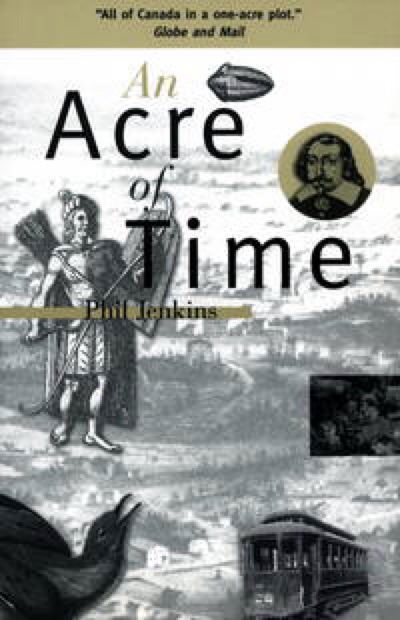
What a peculiar title for a book! But this is also a very peculiar book, encompassing geology, geography, archaeology, anthropology, philosophy, and most notably, embarrassing history, all as they relate to one acre of land measured out by the Gatineau author in downtown Ottawa. Although it’s history goes back to antiquity, he researched this over a three year period between 1993 and to 1996.
In delightful quirky prose loaded with apt similes, metaphors and analogies, in early chapters Jenkins regards humans as minor pesky destructive latecomers in the long history of the acre situated in what is now known as LeBreton Flats. In the first section, he traces the ancient origins of the underpinnings from the core of earth to the surface, some layers migrating from as far away as the equator. In later sections he shows due respect for the Algonquin’s claim to the land, but notes that human ownership of land is a legal myth, at best a lease that can be sold and one that is subject to the whims of natural events.
The details of what has happened to this acre over its long history are stunningly complex and are documented by very careful research from archives and from interviews of diverse surviving former denizens. The site chosen for the title must have been carefully selected in advance as few other places on earth’s surface could match it in controversy and the complexity of its history. The controversies continue to this day and endless plans for the development of LeBreton Flats have been proposed and abandoned in the twenty five years since the book was published.
Among the dozens of insightful quotes: “Heads of state, mayors, multimillionaires, and capital city planners tend to get Pavlovian about empty acreage. When they look at something like the acre, they see a bad case of arrested development and get all determined to build their sandcastles on it.”
The wind is described as “airmailing” dust and moisture onto the acre to provide nourishment for the soil.
Although I have lived 21 k from the acre for the last five years and have been by it many times by car or bicycle, I found the the map at the start confusing and resorted to having expandable and contractable Google Earth open beside the book for orientation, at least to its present state.
There a whiff of perhaps justified scepticism and preachiness in places, and there may be more geographic errors than the one I found. ( A trip from London, Ontario to Stratford is described as going down the Thames River.) To be picky, I found one nonsensical sentence that a proofreader should have caught – “Two policemen also drove up but they were not, and headed back uptown.”
This is a valuable history lesson, perhaps most appreciated by Ottawa residents and historians, but an enjoyable read for anyone.
⭐️⭐️⭐️⭐️for Ottawa denizens. ⭐️⭐️⭐️ for others.
Thanks, Barb P., from Williams Court Book Club 2.


