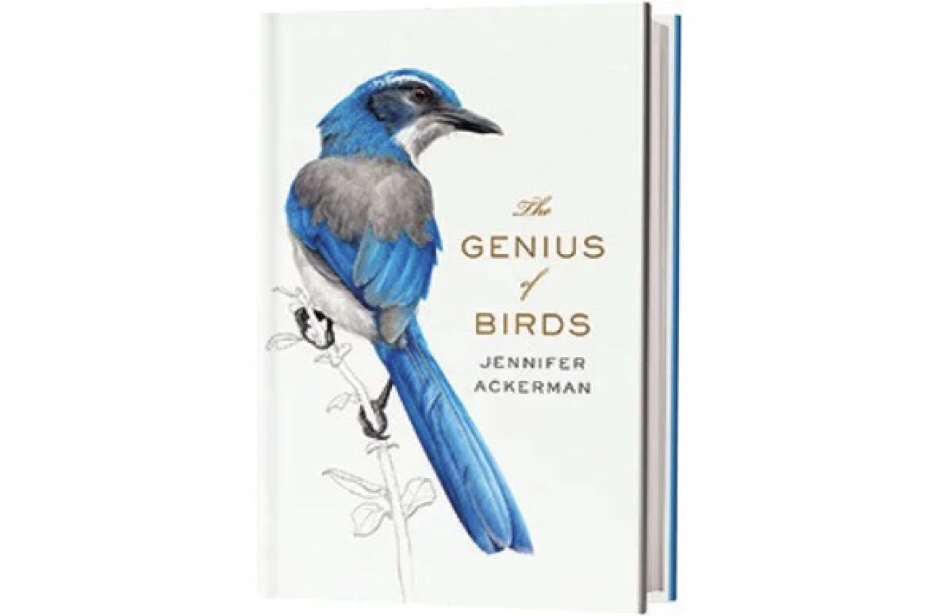
In this incredibly detailed, erudite, and scholarly treatise, (30 pages of notes and a 10 page index) the Maryland author presents a crash course that could be called Ornithology 101. Everything from bird evolution, anatomy, tool making, social and sexual proclivities, songs and communications, neuroanatomy and neurophysiology, and navigational skills to their interactions with other species, is reviewed and discussed. Many of the findings are from academic ornithologists and laboratory scientists from around the globe, but some comes from the observations of that eclectic human subspecies called the Binocularis Homo sapiens avis.
It seems that there are more theories and speculations than proven scientific facts in this rarified world, particularly when it comes to explaining the astounding navigational skills of birds. The 42 pages on migration and navigation includes theories about following clues from stars, magnetism, odours, sound or light frequencies that humans cannot detect, with dozens of ingenious studies failing to explain all of the observations.
There may be no skill left that is entirely confined to humans as one by one they have been discovered in other species, including birds and insects. Perhaps Ernest Becker was right in arguing that human’s only unique trait in all of biology is our awareness of and ability to deny our own mortality, but how do we determine that other species do not share this mental feat of cognitive dissonance?
Fuzzy social science debates about the nature of intelligence and distinctions without a difference between cognition and intelligence highlight our linguistic limitations in describing the amazing complexity of natural phenomena. There are some instances of conflating correlation with causation, and laboratory studies of captured birds may not be duplicated in the wild. The fallback explanation of ‘instinct’ is really no explanation at all, a coverup for our ignorance.
One longish insightful quote: “Many bird species are highly social.They breed in colonies, bathe in groups, roost in congregations, forage in flocks. They eavesdrop. They argue. They cheat. They manipulate. They kidnap. They divorce. They display a strong sense of fairness. They give gifts…. They pilfer from their neighbours. They tease. They share….They may even grieve.”
There is a circularity to the arguments about the relationships between avian intelligence or cognition, adaptability, and survival advantage that I found to be confusing and unhelpful.
I am neither an ornithologist nor a Binocularis Homo sapiens avis but I did help feed and train a great horned owlet for two months. (We had unintentionally scared her from the high nest before she could fly.) And I was fascinated by, on several spring evenings, observing the interactions of a pair of osprey designing and building their giant home on the tall centre outfield light stand of a baseball diamond.The city, to their credit turned off the lights for the season to avoid frying the eggs. As the one, presumably the male, picked up sticks and twigs from the park in his talons and beak, he would invariably do a fly by around his mate perched on the left outfield light stand, then either dropped his cargo and go back for a different load or take it to incorporate it into the nest. I was never able to discern what if any signal she gave him for approval or disapproval, but she would seemingly randomly stand up and spread her wings.
This avian discourse is unparalleled in its detail and the author’s obvious love of her subject and the awe it inspires is infectious. A great read.
⭐️⭐️⭐️⭐️
Andra
Thanks,

 The Passionate Reader
Glad you enjoyed!
LikeLike