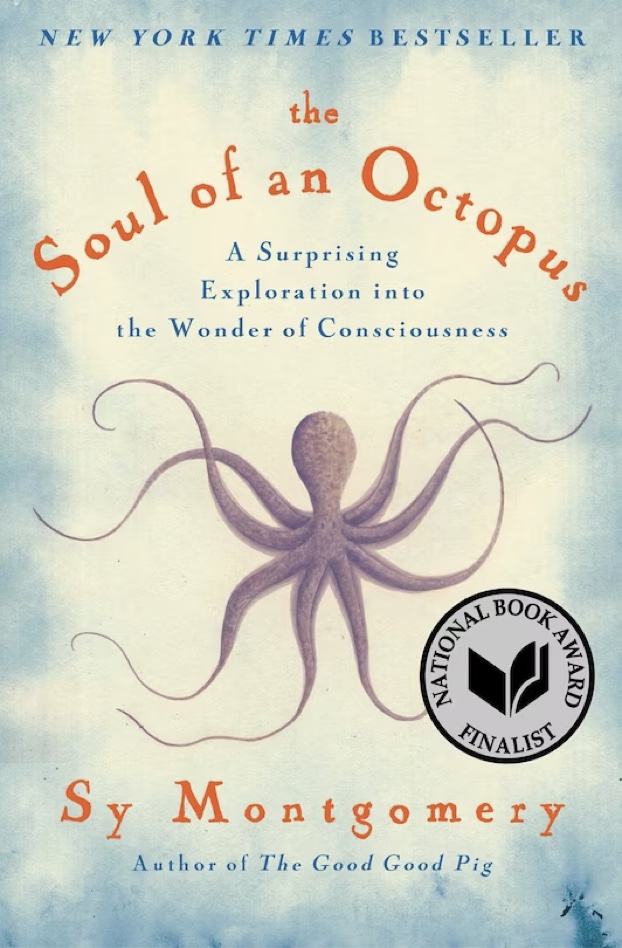
Amazing science findings that challenge our conceptions of intelligence and conscience are always interesting to me. Much of the documentation in this book comes from observations of Giant Pacific octopuses in the New England Aquarium in Boston. They have distributed neurones, independent neuronal control of arms and suckers, fast changing colours and textures of arms, and individual personalities. They learn to navigate mazes and aim water spouts accurately. They can recognize and interact with friendly human visitors, use tools, express emotions, and appear to manage crab ranches. They secrete ink, hormones, and drugs in defence. Their circulatory system involves three hearts. The arms communicate with each other seemingly without any neuronal connections through the central brain, and can regenerate if they are amputated. Does each arm fulfill the human definition of an individual? They possess the ability to, almost without limit, change their size, colour, and shape as shown by one large octopus with an arm span of almost six feet who escaped from her aquarium pool through a two inch hole. They have a form of what psychologists call Theory of Mind, the ability to anticipate and react to the thoughts and actions of others, an ability once thought to be unique to humans. They can design and use tools. They certainly challenge human conceptions of what it means to be a self-conscious individual.
There are some irrelevant diversions in this narrative that have nothing to do with the biology of octopuses, such as the 65 minute chapter discussing the author’s efforts to learn to scuba dive in the Atlantic and Caribbean, her moving of large fish and octopuses to a new aquarium and her philosophical musings about the nature of human consciousness. There are also shorter diversions such as about the trainability of lumpfish, said to be easier to train than any dog breed, and a soppy poetic passage on love of eggs by all mothers in the natural world.
Some of the diversions, such as the observation that male fruit flies when rejected by would-be mates turn preferentially to alcohol- laced water for solace are as interesting as any science of octopuses. And these insect’s seemingly erratic flight paths follow logical algorithms. But after discussing this, Montgomery, in what seems to me be a contradiction, nevertheless concludes that those tiny beings and all living creatures are endowed with free will.
I admire the dedication to science of the author and her colleagues who describe octopuses as beautiful and sexy. But I question their life priories and reasoning abilities when they fly across the continent to attend the mating at the silly annual Octopus Blind Date, a popular annual event at the Seattle Aquarium, even though the reproductive mechanisms of octopuses are complex and unique in nature, as they could observe it in Boston.
There are a lot of superlatives used to describe what the author views as the beauty, talent, and intelligence, of octopuses, as they are described in blatant anthropological terms. There is no doubt that she is sincere and devoted to her eight armed friends but her husband, children, and other adopted pets receive relatively little narrative attention.
⭐️⭐️⭐️⭐️⭐️⭐️/10
Thanks, Book Bub.

 The Passionate Reader