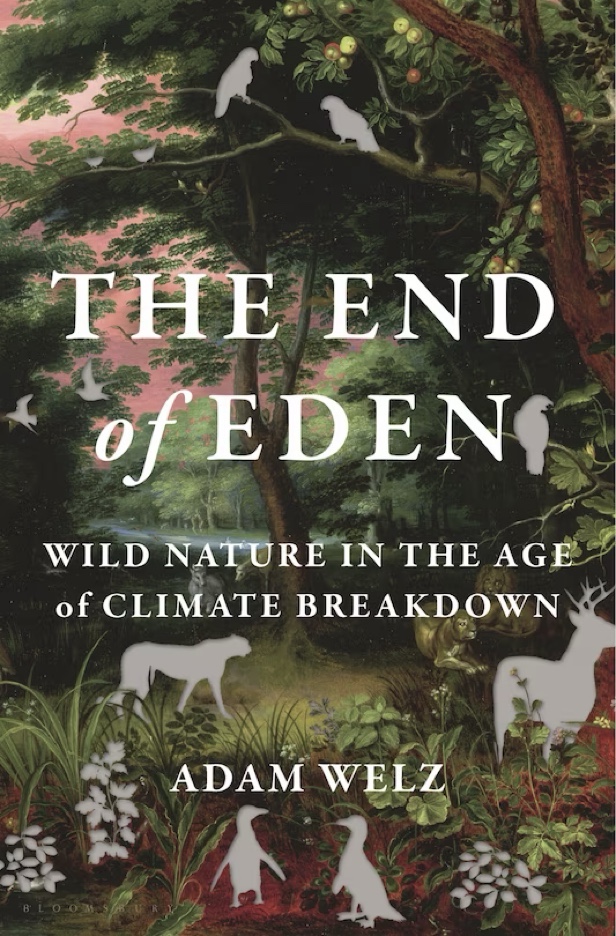
This South African globe-trotting naturalist has produced a very readable documentation of the dramatic and devastating effects of climate breakdown on plant and animal life around the globe.
Basic principles of physics, chemistry, thermodynamics, ecology, physiology, and a bit of meteorology at the undergraduate or even high school level are presented in Chapter 1 as a background refresher.
The most frightening revelation in the ensuing chapter on plagues and diseases is the release of dormant but still infectious viruses and bacterial spores, including anthrax, that are millions of years old, from melting Arctic permafrost carcasses. They are now decimating Norwegian reindeer populations and may introduce new/very old pathogens to other species including humans. This prospect may challenge future epidemiologists. Will the next human pandemic come from a permafrost cadaver? Smallpox?
The increasingly frequency and severity of storms, droughts, and floods, and pollution of the whole ecosystem are all well known, but they are made vivid by the author’s visits to such places as New York City in the aftermath of Hurricane Sandy, the interior of Australia following the record fires of 2019-20, the bleached coral reefs of the Great Barrier Reef and, closer to his home, the loss of hundreds of species of plants in the Cape Floral Region of South Africa due to warming and drying of the air. The marvels of how all species of plants and animals are able to adapt, changing diets, migration routes, and their interactions with other species never cease to amaze me, and some remarkable such feats are discussed here. But those changes do have their limits, dependent as they are, in part at least, on genetic alterations that occur only over thousands of generations and cannot keep up to the rate of change in the environment that we have brought about. Some species such as the American Barn Swallow have become different subspecies because of widening differences in the climate in their winter and summer homes. Since life on earth began 3.7 billion years ago, change and adaptation to the environment has been, but only in the last 200,000- 300,00 years has Homo sapiens emerged as by far the most dangerous, destructive global invasive species threatening the survival of all life forms.
I read one paragraph several times and concluded that the author switched the words “male” and “female” in error in this passage. “Aromatase becomes more active at higher temperatures, converting most of the testosterone in the eggs [of Australian green turtles] into estrogen. Thus eggs incubated at higher temperatures become male, cool nests produce females…..” The facts are that now, in a warming environment, there are far more female than male hatchlings.
The Conclusion is mainly a discussion of how the research and documentation of the extent of man-made climate breakdown has effected the author personally and psychologically and his plea to readers to redouble efforts to do whatever we can to halt what he sees as ever-increasing destruction of life of all forms on earth. Despairingly he comments that “It’s profoundly alienating to carry and communicate important knowledge that people around you won’t act on – and that even you struggle to act on, because you must make a living in an economy whose regular operation causes the problem you’ve identified. To survive, you must make things worse.”
This is a sobering, informative, and important book. In a way it is an updated, more detailed environmental treatise like Rachael Carson’s Silent Spring , with less emphasis on toxic pesticides and insecticides and more on the fossil fuel industry. I won’t say I enjoyed it but I read it with interest and am glad to have had it recommended to me.
4/5
Thanks,
Din, The New Yorker.

 The Passionate Reader
Nice 👌
LikeLike