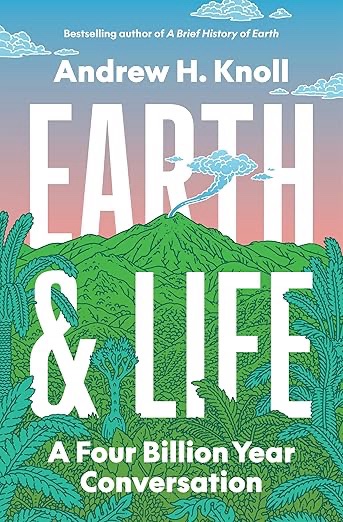
My book choices have been drastically bad lately. I started on two- the 730 page “A Little Life” and “It Will be Different This Time.” The former was exceedingly wordy and boring, and the later was just confusing and silly. I gave up on both by about 100 pages. So when I read about this science book, I was determined to finish it, and I did.
Dense, humourless, and erudite, by a Harvard professor, it outlines in exquisite detail the two-way relationship (he calls it a conversation), between endless forms of life and the constantly changing composition of our planet over millions of years.
In the first third or so, he outlines the current cycles of carbon, nitrogen, phosphorus and some trace elements as they relate to modern life forms. He then delves into the history of the earth over four billion years and the fluctuating changes in those levels and functions as they relate to the evolution of early life forms.
Spanning organic chemistry, archeology, paleontology, cosmetology, astrobiology, biological sciences, and climatology, there is much information that is away beyond my ability to comprehend. The only chapter that I can claim to understand in any detail is the superbly written discussion about climate change, and the challenges we face with that.
The origins of life are discussed in detail, and although panspermia (the theory that life arrived on earth from space) is never mentioned as such, the co-evolution of the planet and life from space debris seems to make the term irrelevant.
Perhaps a few quotes will demonstrate the complexity of this book.
“…anoxygenic photosynthetic bacteria were imperiled as oxygen gas scrubbed alternative electron donors from sunlit waters.”
“Biopedturbation is the terrestrial analogue of the biopedturbation observed on the seafloor.”
“…marine algae produce a compound called dimethylsulfonopropionate…Within the water column, bacterial and photochemical reactions, transform DMSP to dimethyl sulfite…a gas that can escape to the atmosphere.”
I certainly did not enjoy this book, but appreciate the author’s brilliance, and perspective.
2/5
Thanks, The New Yorker.


