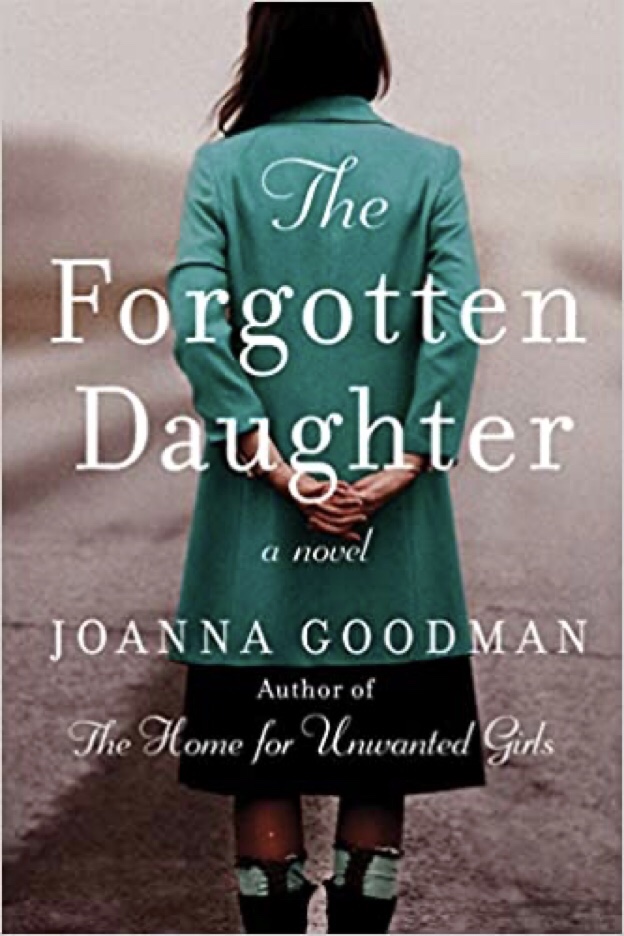
The Forgotten Daughter. Joanna Goodman. 2020. 351 pages. (CloudLibrary)

It may be a bit of a stretch to call this novel accurate historical fiction, but there Is a lot of dark Quebec history from the 1950s to 2001, including the October Crisis of 1970 and the sad plight of the “Duplessis orphans.”

The plot is complex, with deeply flawed characters and interesting geographic and cultural details of the Montreal area of the era. The surprisingly sudden eruption of violent confrontations between separatists and federalists is realistic at least as it was presented in the English Canada media that I followed at the time. Irrational religious fervour combined with historical grudges has, throughout history, led to atrocities.

The writing is fluid and engaging with dynamic dialogue. There are, however, weak points. To make the story work, there are a few very unlikely chance meetings, and portrayal of unrealistic guilt and self-incrimination over what-if situations that never happened. I found the time line of Elodie’s troubled life a bit difficult to follow, having not read the earlier Home For Unwanted Girls, that my wife says features her in detail. The length of time the politically opposite young lovers stayed together seems to be a stretch, based, as it seems to be, entirely on animalistic lust.

The Catholic church’s cruel unapologetic grip on every aspect of Quebec society of that era as presented here may be realistic but will not endear the book to devout Catholics. The physicians and politicians who were complicit in condemning the Duplessis orphans to a cruel childhood in mental institutions do not get off much better. Carlton University is described as “a utopian pit stop on the road to the real world” an apt description for all universities.

To be nit-picky, I found one obvious error-“..Bernard’s neck vein pulsing.” Why can novelists seemingly never understand the difference between veins and arteries?

Goodman portrays all of the separatist zealots as poorly educated, chain-smoking, angry, drunk or high on pot and willing to break
laws by smuggling tobacco, booze and drugs across the border.They express strong opinions about subjects they know nothing about. (My late separatist brother-in-law would mostly fit in with them, although not a criminal.) Many of their federalist opponents are not much better, but they are generally a more law-abiding lot. Her bias as an anglophone Quebecker who escaped to Toronto thus seems obvious.

One great quote among many memorable lines: “Love doesn’t use or discriminate against conflicting opinions or ambitions; it does not divide or bully.” This should have been the last sentence in the book, but there are only two more pages.

This is a powerful portrait of a dark aspect of Quebec and Canadian history in fictional form. We need to be reminded of it lest it be repeated.

Thanks, Vera

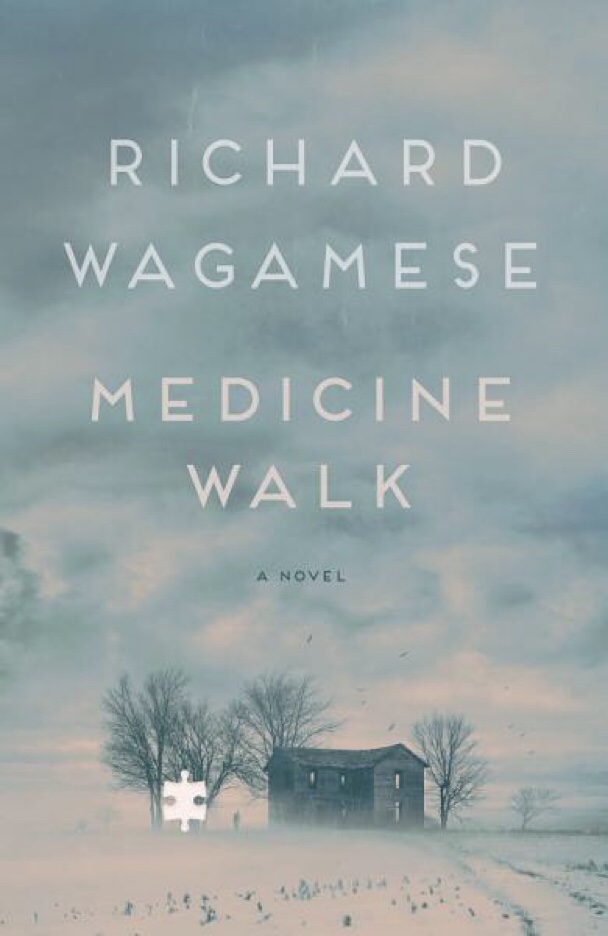
Medicine Walk. Richard Wagamese. 2014. 233 pages.

The late Kamloops Native novelist and poet tells a grim story of a Native teen orphan as he attempts to learn about and come to grips with the tragedies of his family’s past, first in bits and pieces from the old farmer who became his surrogate father and later as he reconnects with his dying alcoholic itinerant biological father.

The description of the hard lives of manual labourers in mines, mills and lumber camps and hardscrabble farmers are vivid, and the legendary native skills acquired by living off the land, hunting and fishing, are described in great details that will be hard for urbanites to believe (even though the details of fly casting are a bit off). The ravages of prevalent alcoholism in the mining and logging camps and the pulp-and-paper town’s boarding houses are described in realistic and horrid detail, as are the horrors of the front line action in the Korean War. The extensive dialogue and repartee in the clipped street slang of the illiterate is delightful.

As the youth takes his dying father out into the mountainous B.C.wilderness with the express purpose of reestablishing a father-son relationship before burying him there, the details of the father’s tragic past gradually come out. Nostalgic sentimentality becomes cloying and a vague but nonspecific typically Native spirituality pervades the whole story. The reader is asked to believe that a man who is rapidly deteriorating and intermittently comatose is nevertheless able to recall and relate his past history in hours-long narrative But the author got the details of dying of cirrhosis largely right with intermittent confusion, extreme anorexia and wasting, jaundice, vomiting of blood, and a pervasive disgusting odour (fetor hepaticus), even though it is usually less predictable in timing than as portrayed here. It is not clear how much of the tragic details in this story are based on the author’s first-hand experience, but in the Acknowledgements, he writes of an “ inward journey”, “braving darkness and shadows”, and “long nights of soul searching.”

The end is largely predictable far in advance, and the characters are mostly likeable realistic rogues, but the morbid details become a bit depressing. Enough of sentimental self-examination and guilt- I am looking for something lighter and uplifting as we enter the start of the second year of living with Covid-19.

Thanks, Michèle

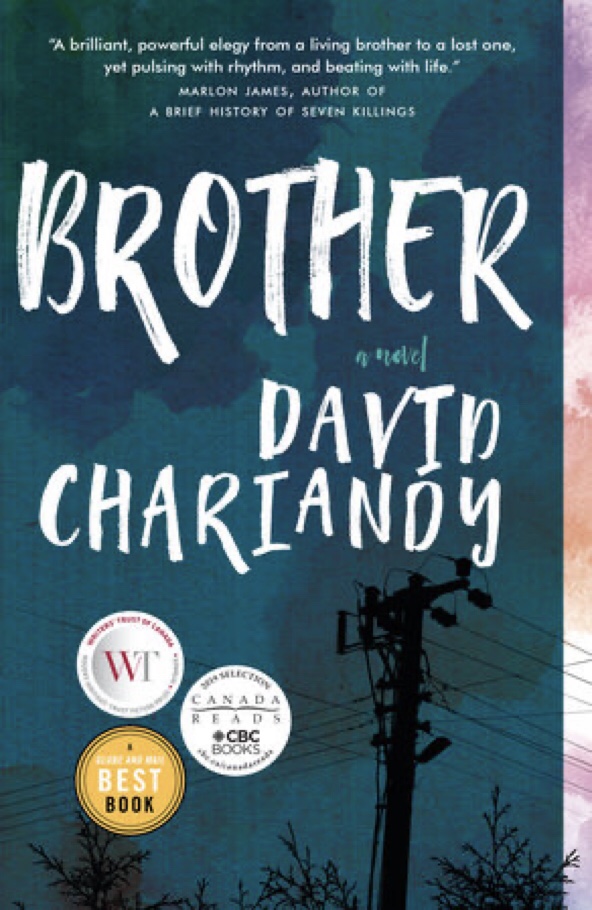
Brother. David Chandigarh 2017, 141 pages

This short novel about a Trinidadian boy growing up in Scarborough with his mentally ill, hard working mother and older brother paints a vivid picture of the poverty and squalor of the area around Lawrence Avenue and the Rouge River valley, in Toronto in the 1980s. It was populated largely by first generation immigrants, gangs of street youth, and broken families trying to eke out a living, largely ignored and despised by their more more affluent neighbours.

The writing is a bit disjointed, as the story is told by the younger brother, in part before and in part after the older brother is shot and killed by the police, with time shifts that can be confusing.There is nothing very profound here although the plight of thousands of underprivileged children growing up in profound poverty in our midst is a stark reminder that we live in a very unequal and unjust world.

A light easy read.

Thanks, Rhynda.

Rebecca. Dauphne Du Maurier 1938, 448 pages

This old classic is on the list for our book club discussion next week, my wife having already discussed it in her book club. It seems everyone except me was intimately familiar with it. It is set largely in western England in the 1920s or 30s and narrated entirely in the first person singular by the insecure, young, shy, second wife of Maxim, who becomes the matron in the rigid hierarchal British aristocrat’s mansion, Manderlay. The detailed character development of the diverse aristocrats and the servants, including the very bossy stern hateful Mrs. Danvers and the no-filter embarrassing sister Beatrice is bound to remind readers of someone they know. The overriding memories of the drowned too-good-to-be-true first wife, Rebecca, pervade every aspect of the daily routine of the mansion. The strict class distinctions, the proscribed gender roles, and the superficiality of the British aristocracy that the author belonged to is subtly mocked in the first half of the story. The narrator who feels like someone with the latter-described imposter syndrome coming from a lower class, struggles to adjust to the expectations, with many challenges from those loyal to and zealously protecting memory of the first wife. There are small hints that the past was not as idyllic as presented and by the halfway mark, the story quite suddenly twists into a mystery with reality intruding into the presentation of what had seemed like a tragic drowning in an otherwise idyllic existence in the Garden of Eden. Suddenly, nothing is as it seemed to be on the surface. I will not give away more of the plot that becomes a complex who-dun-it mystery.

The writing is very British with no explicit description of sexual activities and very Victorian sensibilities, but the sensuality of the characters is a pervading undercurrent. There is little overt humour, but the depiction of the conversation with a demented old lady in the person of Maxim’s grandmother is so timelessly accurate that anyone who has tired to converse with an elderly demented relative will be able to relate to it.

As the second half develops, the plot thickens appreciably and nothing presented in the first half survives unscathed. The tensions between the truth and the fiction are heightened and the interpersonal relations deteriorate as the powers that be come close to disclosing the true story of Rebecca’s death and her continuing influence on the lives of the living.

This is a gem of a story with a vivid depiction of the era in the lives of British aristocrats and a timeless reminder that nothing is as it seems to be on first glance. Although it seemed to drag in places, I enjoyed it immensely.

Thanks, Beth and Vera.

Ten Minutes and 38 Seconds in this Strang World. Elif Shafak 2019. 340 pages

The setting for this strange story is the town of Van, Turkey, and later Istanbul. A young girl born in 1947 to the teenaged second wife of an alcoholic Muslim flees from a sexual predator as a teen, working in the street of legal Istanbul brothels next to a mosque, a church and a synagogue. The silly premise of the title is her recollections of her life as her brain dies in the ten minutes and thirty-eight seconds after her heart stops when she is murdered and thrown into a dumpster. But her recollections take up the bulk of the book, requiring several hours to read.

The schizophrenic surrealism of Istanbul, with its multiple contradictions is well represented as the prostitute is befriended by a transsexual woman, a gay man, a devout female Muslim dwarf, and a female nightclub singer/dancer. The blending of different religious beliefs and superstitions entwines all the characters with no sense of any contradiction.

After the protagonist’s death and burial in the real Cemetery of the Companionless outside of the city, the ragtag group of friends attempt to retrieve her body to give her a proper burial, in what turns out to be hair-brained hilarious plot that does not go exactly as planned. This is the best part of the whole tale.

As an introduction to the culture of the city that can’t decide if it is Asian or European, Christian or Muslim, cosmopolitan or parochial, this is a good read.

Thanks, Rhynda.

The Shack. Wm. Paul Young. 2007, 248 pages.

This peculiar novel starts off as a fairly typical thriller/detective mystery involving the the disappearance of a small girl from a family campground park in Oregon. Suddenly, in a Pauline road-to-Damascus kind of experience, after four chapters, it suddenly veers off into mysticism and magical realism as the protagonist, on a secret visit to ‘the shack’ encounters God the Father as a cheery, chubby black woman with a southern accent, Jesus, as a Middle Eastern man, and the Holy Spirit as a wispy small oriental woman. Over two days this trinity work to enlighten him on the mysteries of the universe, and relieve the lingering burden of his grief from losing his daughter. Mystical allegory, trite aphorisms, magic realism (he walks on water with Jesus), plain magic (resurrection of the dead) and surprising theological lessons based loosely on early Christian teachings is mixed into a theological/philosophical discourse that could fill a whole semester in a theology or philosophy course. Most of these lessons would fit better into a Unitarian discourse than the sermons of dogmatic evangelical Christian clergy. Jesus reveals that he is not religious and not a Christian. The life outlook of the protagonist is forever changed for the better.

Much of the teaching from the Trinity on that weekend is an attempt to reconcile the notion of a loving omnipotent, omniscient deity with the universal human experience of physical and mental suffering. Like C.S. Lewis’s The Problem of Pain or Rabbi Harold Kushner’s When Bad Things Happen To Good People, this attempt does not quite succeed, in my opinion. There seems to be no questioning of the existence of human free will, or of the problematic doctrine of original sin.

An ingenious twist just a few pages from the end kinda, sorta explains the earlier journey into fantasyland and at least brings the story back to earth. The story has been adapted to a 2016 movie starring Sam Worthington, Octavia Spencer, and Tim McGraw that I have not watched but it might be worth a peek.

There is far too much ethereal spirituality with unquestioning acceptance of the existence of a benign deity that interacts with us here for this secular humanist. But just as reading the political works of those whose outlook is opposite of your own is sometimes useful, I gained a new understanding of how deeply religious folk think from reading this book. It is better to engage and try to understand than to blindly oppose. I am sure that many even semi-religious folk would enjoy it more than I did.

Thanks, Joanne.

Factfulness. Hans Rosling, 2018. 259 pages.

The late Swedish WHO public health physician toured the world giving lectures and quizzes to executives, intellectual leaders, professional associations, educators, Nobel laureates and politicians, including the elite at the Davos World Economic Forum. He uses the responses to his multiple choice quizzes to analyze why these highly educated individuals systemically provide the wrong answers, usually doing worse than chimpanzees that pick answers at random. The correct answers are usually not disputable, being derived from large UN and WHO databases.

Of the 12 fact questions about common important problems that he starts off with, no country’s highly educated respondents on average did better than chance in their answers to any, and most did worse than chimpanzees pushing one of three buttons at random. I was quite proud of my correct response to 8, at least better than the chimps.

In the bulk of the book, a systematic analysis of ten common instincts that lead most of us away from factual realities are exposed and suggestions are made to counteract them. Although the media with their bias toward the sensational but unusual comes in for early blame, he acknowledges that journalists are just providing what sells. “I cannot see even the highest-quality news outlets conveying a neutral and non dramatic representative picture of the world… it would be correct but just too boring.” But I have a suggestion. It may be beyond government power, but news organizations could require or at least request that their outlets balance their bad news stories such as natural disasters, wars and the spread of pandemics with an equal number of good news stories, many of which could come from the upbeat data in this book. e.g. “Today, the world set a new record low for the number of people living in extreme poverty.” Or “1.6 million people flew on 145,000 commercial flights today and they all landed safely.” A great New Year’s resolution for any reporter.

The overall message, like that of Rutgers Bregman in Humankind and Steven Pinker in The Better Angels of Our Nature is that the world is getting better, and of the three, this provides the best proof and is by far the easiest read. The writing is well organized, delivered with acknowledgment of the authors failings, and humorous self-deprecating anecdotes. It is little wonder that both Barack Obama and Melinda Gates have lavished praise on this work.

Brilliant, timeless, loaded with counterintuitive flawless insights and sage advice, reading this book will forever drastically change your wold view regardless of your background.

Thanks, Andra.

The Better Angels of our Nature. Steven Pinker. 2013. 704 pages.

This thick volume starts off with a discussion of the rates and reasons for violence in our ancestors from the time of our divergence from other primates to Biblical times and then on to the Middle Ages, and the 20th century, including the prominent role that religious institutions and beliefs played in promoting violence and genocides. “Whether or not the Israelites actually engaged in genocide, they certainly thought it was a good idea.” The author is a Canadian-born atheist of Jewish background at Harvard.

The Humanitarian Revolution chapter veers a bit off course into long quotes from Voltaire, Samuel Johnson, Blaise Pascal, Denis Diderot, Shakespeare, Emanuel Kant, Thomas Payne, George Washington, Thomas Hobbes, John Locke, Adam Smith, Rene Descartes, Edmund Burke, Baruch Spinoza, and Charles Montesquieu in what seems to me to be an unnecessary effort to show off knowledge. But the conclusion that literacy, particularly the reading of novels, together with urbanization, led to abhorrence of previously sanctioned violence seems valid. Enlightenment humanism, (which I embrace as opposed to religious dogmatism), slowly evolved to emphasize our commonalities.

In trying to explain the (relatively) Long Peace following WWII, Pinker utilizes statistical modelling including Poisson distribution, power-law modelling and multiple logistic regression applied to the magnitude of wars. Statistical manipulation of derivatives of derivatives with arbitrary time frames seem at times to be designed to convince readers of a dubious conclusion. Nevertheless his conclusions that the rise of democracy, increasing international trade and organizations, urbanization, and education about other countries and peoples are potent anti-war weapons seem valid. The same statistical modelling of extensive data lead to the conclusion that civil wars, terrorism, and mass killing of political and ethnic groups (genocides), dependent on exclusionary ideologies have also dramatically declined in the last 40 years, contrary to what we usually hear from doom and gloom talking heads and politicians who oblige the terrorists by trying to scare us. In the long chapter documenting the rise of individual rights and the resultant decrease in rape, assault, domestic, child, and animal abuse, there is a superb snide discussion of the evil unanticipated consequences of efforts to ensure childhood safety.

The Inner Demons chapter is like thick molasses-far too heavy on neuroanatomy (and psychologists interpreting brain images) for most readers to digest or even wade through. And I am really tired of reading endless descriptions of experiments on social science undergrads paid beer money to participate in complicated and devious manipulations dreamed up by their professors. The division of reasons for evil into five arbitrary categories, and discussion of them is nevertheless interesting. But the fifteen pages devoted to Ideology is just an expansive documentation that peer pressure is powerful.

In The Better Angels, Pinker lays out several trends that go some way to explain why every parameter of life has, on average, never been better in the history of Homo sapiens, than at present.The Flynn effect documenting a world-wide increase in intelligence of average human beings was news to me. And the thirty-fold decrease in the risk of dying a violent death in the last millennium is striking.

After the book was written, Russia and Syria disproved his claim that no country would ever again use violence to change borders of a neighbouring one or deploy chemical weapons. And the Trump-era rise of white supremists has reversed the downward trend in racial violence documented for the previous half century. He could not have easily foreseen the rise of asymmetric warfare with drones that create moral dilemmas and inevitably will increase the temptation to start wars. Perhaps he addresses these in his 2018 Enlightenment Now that I have not read (nor am I likely to).

If the reader can get through the long catalogue of nauseating common atrocities in every stage of life, accepted as normal by our ancestors, the overall lesson from this tome is that we have never had it so good, an upbeat message that compliments the much more concise conclusion in Rutgers Bergman’s Humankind.

Scholarly and erudite, the writing is dry and humourless. There are almost 300 pages of Notes, Bibliography, and Index, along with sixty graphs. But I am in awe of the vast amount of information the professor conveys and his ability to grasp the connections from studies in diverse disciplines, and come to counterintuitive conclusions. For example, early on he is trashes Stephen Levitt and Steven Dobner’s Roe vs Wade explanation in Freakenomics for the late 1980’s crime decrease in the U.S.A., and discusses alternative, if inadequate, explanations. “The world has far to much morality….The human moral sense can excuse any atrocity in the minds of those who commit it.”

Who should read this book, which Bill Gates says is one of the most important books he has ever read? (My cynical nature makes me question how much of it he has actually read.) Certainly any social science researcher, professional negotiator or university-level historian. It will stay on my bookshelf as a reference volume, although I cannot say that it was a pleasant read.

Thanks, Andra.

A Promised Land. Barack Obama. 2020. 702 pages

This is not an easy book to review, much less to criticize. The 43rd president of the United States documents his path from an impoverished childhood to the May, 2011 successful military raid that killed Osama Bin Laden in this Volume I. (In spite of his moral integrity, he never addresses the criticism that Bin Laden should have been captured alive to face Justice in a court of law, which would have raised all kinds of jurisdictional disputes.) Along the way, dozens of high profile politicians, and world leaders who are household names come to life as he describes his interactions with them, from the flamboyant Nicholas Sarkozy to the two-faced opportunistic ultra-partisan Mitch McConnell.

Predictably, the controversial decisions he was forced to make are defended with careful reasoning that is hard to argue with, based as they almost all were on the advise of the brightest and most dedicated advisors that he recruited to work with him. Unlike his successor, he is introspective and self-questioning, agonizing over the effects of his policy decisions, not only on Americans but on other citizens of the world. He rejected a proposal to kill Osama with a drone strike on his villa because several women and children would inevitably also be killed. His hospital visits to wounded military personnel and his insistence on being present when the bodies of fallen soldiers are returned home reveal a compassionate conscientiousness that is rare in modern politicians. His efforts to provide a normal childhood for his daughters are a stark contrast to the disregard for the welfare of other family members of the current president. He is generous in his praise of others who show an ability to follow their consciences regardless of their party affiliation and scornful of those whose actions are entirely based on self interest, particularly Mitch McConnell, John Boehner, and Donald Trump. His grasp of the background history leading to current world political dilemmas is quite profound. This book, although long, could serve as a primer on modern world history from the 1960s up to 2011. He recognizes his tendency to wordiness and it shows in the book. “If every argument had two sides, I would usually come up with four.”

On his past ability to connect with ordinary citizens: “ I wondered if any of that was still possible, now that I lived behind gates and guardsmen, my image filtered through Fox News and other media outlets whose entire sorry business model depended on making their audience angry and fearful.”

On leadership. “Looking back, I sometimes ponder the age-old question of how much difference the peculiar characteristics of individual leaders makes in the sweep of history- whether those of us who rise to power are merely conduits for the deep relentless currents of the times, or whether we’re at least partly the authors of what’s to come.”

There are hundreds of verbatim quotes, some of which I suspect must be paraphrased, unless he has had a tape recorder strapped to his body continuously since he was a teen. I am in no position to argue with his decisions on banking reform, health care reform, immigration reform, or climate change mitigation, but there is no doubt about his sincerity and willingness to sacrifice political popularity in pursuing goals in these areas.

This is a great educational tome from a rare humble man of integrity who deserves much more recognition and praise than he has received in the last few years. I am sure that he made many errors, and he would not deny that, but can anyone seriously imagine his successor writing such an honest eloquent treatise? Can he even write a grammatically correct sentence?

Thanks, Din.

Apart from the understandable but dubious claim that the United States is the greatest nation on earth, which is not true by any meaningful metric that I have encountered, I cannot find any fault with this enlightening book. I am looking forward to Volume II.

Resurrection. Leo Tolstoy. 1899, 561 pages

I recently found this old classic on our bookshelf, complete with a faded St. Petersburg postcard, which indicates that I previously read it over thirty years ago. With no recollection of the details, I reread this 1966 Rosemary Edmonds translation.

Prince Dmitri Ivanovich Nekhlyudov, an aristocratic landowner seduces and impregnates the charming Katerina Maslova, a.k.a. Katusha, then abandons her. Later he spends years trying to assuage his guilt as she descends into a life of prostitution and crime. She is sentenced to hard labour in Siberia for a murder she unwittingly contributed to. I won’t give away more of the complex plot except to say that Tolstoy uses the extensive moral self-examination of Nekhlyudov to covey his late-life blistering socialist condemnation of the stratified Tsarist Russian society of the 1880s, the hypocrisy of the Orthodox Church, and the cruel criminal justice system that punishes poverty and maintains the elevated status of the real criminals in the aristocracy. If he had been born slightly later, Tolstoy would probably have been a prominent Marxist Bolshevik.

There are many great timeless observations, highly relevant today. On peer pressure: “At first Nekhlyudov made a fight for his principles but the struggle was too hard, since everything he considered right when he put his faith in his own conscience, was wrong according to other people and vice versa…”.

On human nature: ..”whatever a man’s position may be, he is bound to take that view of human life in general that will make his own activity seem important and good.”

On the organization of (Russian) society: “a society where the suffering borne by millions of people in their efforts to ensure the convenience and comfort of a small minority was so carefully concealed that those who benefitted neither saw nor could see this suffering and the consequent cruelty and wickedness of their own lives.”

Many observation such as the prisoner Simonson’s religious beliefs in panpsychism are ahead of their times and are echoed in later philosophical writings. The dangers of blindly following orders ‘from above’ are exposed long before Nazism. Although all religious dogmas are dissed, Tolstoy seems to accept as a given that some vague deity dictates rules for human behaviour, as demonstrated in the last few pages when Nekhlyudov finally finds peace and joy in rediscovering the message of Jesus in Matthew, chapter xviii, and in the Ten Commandments.

As in all Russian literature, the long unpronounceable names with multiple patronymics can be confusing to western readers, but there are fewer main characters here than in War and Peace.

In some ways this is similar and complementary to Dostoyevsky’s earlier Crime And Punishment, but I found this a more enjoyable read. Most critics rate War and Peace and Anna Karenina as Tolstoy’s best novels, but to me this later one is vintage Tolstoy at his very best.

F

Lightning Flowers. Katherine E. Standefer 2020, 248 pages.

Part memoir, part scientific inquiry into the origins and destinations of all the components of her implanted defibrillator, the young author with a genetic heart rhythm defect visits the California assembly plant of St. Jude’s Medical, nickel, cobalt, zircon and ilmenite-titanium dioxide mines in Madagascar, Busaro, Rwanda and the remnants of a Johannesburg gold mine. The Rwanda site is the source of rare ‘conflict minerals’ smuggled in from Congo and sold on into global supply chains ending up in various electronic devices and the aerospace industry. Nevertheless she concludes that small artisan Rwandan mines are less problematic than large international operations in spite of the latter’s cosmetic, negotiated remediation, restoration and mitigation projects that often ignore the priorities of the local residents.

Perhaps the most interesting sub-story for a Canadian reader is the lunacy of the American misnamed health care system. The author is constantly worried about the costs of her care, has to move across state lines and lie about he employment status, and finally gets insurance that only covers her care for specific conditions, in specific places, by specific providers and for specific time periods. “The system is not built to deliver care. It is built to maximize profit….of pharmaceutical companies, medical device manufacturers and ‘not-for-profit’ hospitals that set high prices to pay their executives millions.” In discussing the system’s obsession with codes for specific services that may or may not be insured, she notes “Never mind that Jesus himself did not, to my knowledge, present Lazarus with an itemized bill.”

Along the way, the author unwittingly reveals her major character faults to her readers, without any acknowledgement or acceptance of them. Yes, she has been dealt a bad genetic hand, and on that basis deserves some empathy, but her whining self-pity becomes cloying, and she seems to have developed what social scientists call learned helplessness. She refuses, against medical advice, to even slightly modify her addiction to extreme exercises in order to reduce her risk of sudden death, and stops taking prescribed medication without discussion. I always tried to understand the patient’s perspective and priorities, but if she were were my patient, I would have, after discussion, politely wished her good luck, and terminated the relationship.

The writing is disjointed temporally and geographically with time shifts that just do not work. She describes her first impressions on seeing the Mayo Clinic complex before discussing the phone call from that facility while driving to it. Morsels of philosophical musings are scattered throughout the book but never ripen into anything chewable. Echos of Ernest Becker in Denial Of Death appear: “To live is to forget death long enough to move into the everyday acts of living, to believe them meaningful.”

There are glaring factual errors. The pericardium is described as “the outer muscle of the heart”. A catheter in the femoral artery is fed up the inferior vena cava! A chest tube insertion is said to be able to prevent cardiac tamponade! As she is flying from Tucson to Chicago she describes looking down on islands in Lake Erie.

In spite of the interesting thesis and the medical details that will interest lay readers, I cannot seriously recommend this book to anyone.

The Overstory. Richard Powers. 2018. 502 pages.

Cleverly divided into major sections named Roots, Trunk, Crown, and Seeds this epic pan-psychic allegorical story starts off with eight seemingly unconnected tales of the early lives of unusual or even bizarre disparate American misfits. I was almost ready to give up until I hit page 114, but my daughter had assured me that the seemingly unrelated weird stories all were complementary and conjoined. Then tears of joy blurred the pages as I read the life story of the entirely fictional but fascinating Dr. Patricia Westerford and her laser-focused efforts to understand the secret lives of trees, and their means of communicating to each other, to us, and to the whole living world. Like some of the unusual dedicated scientists and preservationists on PBS’s Nature, her quaint quest is extremely endearing. She is a fictional character, but both her character and the surprising science she relays to the reader seem to come directly from the notable U.B.C. Professor of Forest Ecology, Dr. Suzanne Simard, and her TedTalk about trees.

And, sure enough, in Trunks, the ragbag misfits start to come together in what is made to seem realistic and natural ways, although you may need to go back and reread parts of the Roots section to connect all of the dots. I could not see how the crippled millionaire video-game developer could possibly fit into the story, but late in the Crown section, Powers makes it seem natural to involve him in a major role.

The writing is smoothly poetic with hundreds of stand-alone words and phrases. “High school tries to kill her. Viola, in the orchestra, the maple howling with old hillside memories under her chin.” A hugh number of startling facts are conveyed with nods to the classics in literature, folklore, sciences, mythology, and philosophy. A not-at-all subtle condemnation of unfettered capitalism in the worldwide forestry/logging industry is coupled with a less direct but equally damning critique of legal systems that support it. Dr. Westerford agonizes over the irony of writing and publishing a book promoting forest preservation that will be made from the destruction of forests. As she prepares to address an environmental group called Home Repair she muses “These people need dreams of technological breakthrough. Some new way to pulp poplar into paper while burning slightly fewer hydrocarbons….The home repair they want is just a slightly less wasteful demolition. She could tell them about a simple machine needing no fuel and little maintenance, one that steadily sequesters carbon, enriches the soil, cools the ground, scrubs the air, and scales easily to any size. A tech that copies itself and even drops food for free.”

This is a panoramic, profound, richly interwoven tribute to Gaia, the Greek earth goddess, cautionary, timeless and highly relevant. I cannot think of another novel with such an urgent message. Perhaps Orwell’s Animal Farm allegory comes close, with its very different message for a very different age.

I highly recommend this book. But read the e edition, listen to the audiobook, or borrow the paper one to avoid further destruction of trees.

Thanks, Alana.

Anxious People. Fredrick Backman 2020 335 pages.

This is a silly, impossibly unrealistic tale of a group of idiots who cannot do anything right, including robbing a bank. None of the characters are at all like the faces they present to the world. But it is told with such wry mockery of their incompetence, biting wit, and keen insights into foibles we all share that it is an engaging and fun light read. And the plot has many twists that seem impossible until they suddenly don’t. Some of the author’s comments about behavioural quirks that we all share are quite profound. “When you’re a child, you long to be an adult and decide everything for yourself, but when you’re an adult you realize that’s the worst part of it.”

Like the characters in Tyler Keevil’s No Good Brother, no one here is entirely despicable, and they can all elicit some sympathy. In my estimation, this novel is far better than Blackman’s Beartown, but not as good as his A Man Called Ove, which I loved. Those are the only other books by Blackman that I have read. But this is still a fun light read if you need some diversionary cheering up in the age of Covid.

Thanks, Alana

Dreaming Spies. Laurie R. King. 2015. 331 pages.

I recall reading one of this author’s 12 previous novels featuring the more modern fictional Sherlock Holmes. I remember no details of The Beekeeper’s Apprentice, but enjoyed it, so when my wife borrowed this one from the library, she thought I might like it. Set in 1924-25 on a cruise ship, then in Japan and Oxford, England, the venerable detective pursues international blackmailers and assorted criminals creating a black market in fake works of art.

But the Sir Arthur Conan Doyle creation of Holmes has not aged well and his narrating wife, detective Mary Russell is also no master sleuth here. The plot is predictably convoluted, but very unrealistic with more loose ends than a worn-out hairpiece. It is never made clear why a particular book given to the English monarch by the de facto Japanese emperor is so valuable as to warrant theft, murder, and international scandal, nor is its site at end revealed, unless I missed that in all the revelations about fakes.

The details of the rigid, isolated, and hierarchical Japanese culture of the era are the most interesting depictions. The almost equally rigid world of upper crust England is also well displayed. “He was the sort of aristocrat in whom generations of in-breeding and privilege led to a belief that his ermine robes were not only deserved but proof of the rightness of the universe.”

Not a book that I can recommend to anyone unless you are addicted to the murder mystery genre. Even if you are, there are lots of better tales to choose from.

Japanland. Karin Muller. 2005, 304 pages.

An alternative title for this autobiography by the globetrotting Swiss/American adventurer and photojournalist could be ‘The Westerners Guide to Japanese History and Culture’. Narrated in the first person singular present tense, she relates her attempts as a 35 year old single foreigner to embed herself in their society and learn about what makes them tick, over 12 months in 2001.

The rigid, hierarchical structure of Japanese society extends to everything, including how one is supposed to present and exchange business cards. The older women seem to accept and revel in their roles as strict matriarchs in the home, and younger women are expected or forced to quit working and marry someone of her parent’s choosing before they turn 30. The mixture of Shinto and Buddhist traditions with painful self-sacrifice on long pilgrimages to dozens of sacred temples is fully embraced by the uniquely adventurous author, sometimes with extremely amusing consequences. By the end of her adventurous year, Muller grants the Japanese a grudging respect for their way of life, even as she is thoroughly defeated in judo by an ancient frail master, even though she has earned a black belt. But she does not gloss over the negatives such as the homelessness, xenophobia, and pervasive alcoholism.

Her many social faux pas are detailed with hilarious self-deprecating humour that pervades the whole book. Her willingness to take risks especially on the arduous quasi-religious pilgrimages is sometimes hard to believe. After a meal of fresh raw seafood on a freezing beach and before a ceremonial naked midnight dip in the frigid sea: “There is a riot going on in my intestinal tract. That overly fresh dinner is clawing it’s way out. The slugs are dragging bags of sea urchin eggs like Santa Claus, and the oysters are slithering around in search of their shells. Even the squid is squirting up the aftertaste of six-week-old fermented ink.”

I am left to wonder how much Japanese society has changed in the 19 years since this adventure was undertaken, but it seems so deeply rooted in peculiar traditions that change will only come about slowly, and some changes may be for the worse.

I found a couple of clear grammar and spelling errors that the proof readers should have corrected.

As an introduction to a unique very ancient rigid society that is very different to anything in the west, this is a great enjoyable read.

Thanks, Linda.

Notes From An Apocalypse. Mark O’conner. 2017, 231 pages. 9.5 hours.

I accidentally deleted my review of this from a few weeks ago, so I am redoing it from memory. This Irish father of two muses about when and how the world of human beings will end as end it certainly will. Whether we disappear suddenly due to a nuclear war, a massive unforeseen natural disaster or more slowly because of something like climate change, is unknown, as is the timeline. This could be considered as a real downer or as a call to action to at least delay the inevitable. He frets about the ethics of bringing future generations into an uncertain world and acknowledges his own guilt in contributing to the demise by flying around the world and using up scarce resources in a wasteful capitalist consumer-oriented society.

He visits and mocks the residents of the huge bunkers in North Dakota occupied by preppers who think only of their own survival, with their paranoid misogynist, anti-Semitic selfish ideology, aligned with libertarian political ideology. Then he visits a California Mars Society convention organized by equally selfish individuals who plan to escape any earthly apocalypse by colonizing the red planet. He notes that the survival from natural disasters in the past has always depended on collective selfless community actions, and that the environment of Mars is and always will be less hospitable to humans than that of Earth, even in the worst case scenarios. He visits the equally selfish huge estate that Peter Thiel of PayPal fame has purchased in New Zealand along with his purchase of New Zealand citizenship. Lastly he visits the devastated Chernobyl Exclusion Zone to see what the world without us would look like forty years on a la Alan Weisman’s “The World Without Us.

The message in this is that we can collectively help to mitigate and delay the apocalypse if we each do our part, and his humorous tender interactions with his small children make it seem imperative that we do so. I, for one, even with a dwindling reservoir of altruism, would prefer to go down with Mothership Earth, than to live with the guilt of knowing that I could have helped some non swimmers to safety, and didn’t. Like Solzhenitsyn’s One Day in the Life of Ivan Denisovitch, this is a surprisingly upbeat message about enjoying the simple things in life, and a call to do what we can to preserve what we have. I really enjoyed it.

The WEIRDest People In The World. Joseph Henrich. 2020, 520 pages

I guess that I am WEIRD (Western, Educated, Industrialized, Rich, and Democratic), as defined by this Harvard social scientist who spans ethnography, psychology, and anthropology. I certainly belong to a WEIRD society, although I am only one generation removed from a partially kin-based patriarchal society in which six or seven closely related nuclear families bonded and worked together in a loose, non-monetary, informal, agricultural society, and never kept score, paying farm helpers only if they were unrelated, more like an early medieval society than a WEIRD one.

The influences of a host of factors including genes, environments, religions, climate, and geography over millennia are explored in an attempt to explain how we became the minority WEIRD society in the world. An encyclopedic range of facts is cited and what seems like a few thousand observations and experiments from all of the social sciences. In many ways, this dense tome extends the work of Jared Diamond in Guns, Germs and Steel, and builds on the theses of Francis Fukuyama in The Origins Of Political Order, as it relates to the development of modern institutions and legal processes.

Chapter 6 on the role of the self-serving edicts of the Church in promoting individualism, universalism and critical thinking by restricting marriage options is very perceptive and well worth reading. And Chapter 13 (of 14) presenting the reasons in cultural evolution for the late explosion of inventiveness has some fascinating insights. But some of the dozens of maps, scattergrams, and histograms, all in impossibly small print, scattered throughout the book and appendices are problematic for anyone schooled in data manipulation and statistical analysis. Although Henrich cautions the reader early on about the non-generalizability of studies of unrepresentative Western university undergrads and the hazards of equating correlation with causation, he uses such studies liberally to come to conclusions based solely on correlations, some of which may not even reach statistical significance. He uses artificial constructs such as the Kinship Identity Index and the Generalized Trust Question to derive those correlations. Mark Twain, among others, popularized the cynical observation that ‘there are three kinds of lies; lies, damn lies, and statistics’. How seriously should we take conclusions based on convoluted experiments on remote jungle tribespeople dreamed up by social scientists ‘over a few pints’ in a Vancouver pub? And I for one am not very interested in distinctions between the meaning of the words clan, chiefdom, tribe, fiefdom, stratified chiefdoms, state, and kingdom, given the problems of different nuances of these words translated into dozens of languages.

Henrich has reviewed a massive amount of data and is undoubtedly brilliant. The 190 pages of appendices, notes, bibliography, and index attest to the amount of work that has gone in to producing this humourless, dry, and wordy treatise. After reading this and Rutgers Bregmans Humankind, I dreamed up a recipe for a feast of optimism about the future of our species: take the overriding message here that human psychology is very malleable, stir in a generous dose of Bregman’s positive vibes about human nature, and add a dash of aged common sense.

I persisted to the end, so now you can talk about it intelligently without reading it, but I did so only by taking frequent breaks to read a chapter of an easier book, and I skipped the middle parts of a few windy long paragraphs. But I admit that I learned a lot in spite of my reservations, and probably have had new circuitry wired in my noggin. E.g. What is the origin of the word anathema? Why is my son’s wife known as my daughter-in law? And being Protestant increases your risk for suicide- not just a correlation.

Given the rave reviews this book has received in The Atlantic, The NewYorker, The Economist, and The New York Times, its spine displayed prominently on a bookshelf behind a T.V. talking head would be viewed as an asset. But it will not be on my bookshelf, even though it is a great reference source for academic social scientists-it is back in the library for someone else to struggle through. But maybe that’s because I am not just WEIRD, which is after all just a clever catchy play on words and only meaningful in one language, but also weird.

One Day. Gene Weingarten. 2019, 254 pages

True stories about what happened to ordinary and not so ordinary Americans over the day of Sunday, December 28, 1986 are related in gripping prose in this interesting book by the two-time Pulitzer Prize-winning Washington Post reporter. The date was chosen at random by two children and a waitress in a D.C. diner where the author and his publisher dined as they planned the outline. With the only restriction being that it had to be between 1969 and 1989, they had agreed to accept the date and find interesting people to relate what had happened to them on that date, often interviewing surviving friends, family members, coworkers and acquaintances.

From the gripping detailed story of a pioneering heart transplant, (with an interview with the recipient) at a Virginia hospital after a murder-suicide to the more mundane, most of the stories involve tragedies or heart-wrenching decisions by tormented individual Americans. Yes, all the stories are from the U.S.A. Only one does not feature the main event in the subject’s lives as occurring on December 28, 1986- it seems as though the author felt obliged to include one story about gender switching. Several relate the experiences of different individuals in different parts of the country, on themes such as AIDS, racism, crime, immigration, politics, and the strange background of the troubled former Ottawa Senator’s forward Bobby Ryan aka Bobby Stevenson. How the nineteen main stories were chosen is a bit of a mystery that Weingarten does not divulge. He may have enough material for a sequel using a different date as a focus.

The writing is straightforward prose loaded with humorous small details, in spite of the horror of some of the events, and a keen eye for the quirky twists of the real character’s lives, some famous, but many not well known. It is well researched with over 500 interviews, and extensive searches of archival material. In the Acknowledgments Weingarten realizes that there will inevitably be errors in any work based on people’s recall of distant events.

From the last story: “We are all serving time on death row; only the length of our stay is indeterminate.” From the Acknowledgments: “ He has the sensitivity of a corduroy condom.”

A great peek into the complexity of American culture in a bygone era.

The Friend. Sigfrid Nunez. 2018. 191 pages

The narrator of this peculiar novel addresses most of her comments to her dead male writer friend who has taken his own life. The disjointed story with hundreds of quotes from writers, most of whom I have never heard of, and mostly quotes about writing, is set, with a simple plot, at an indeterminate recent time in New York City, in the eclectic writers community of which she is a part. The link between the narrator and her dead friend, besides their writing careers, is a massive abandoned Great Dame named Apollo, adopted by the friend and then handed off to the narrator by his widow, Wife #3.

Part Six composed of musings about the miseries, jealousies and insecurities of novelists and particularly the ‘creative writing’ crowd seems, at first reading, to have only a tenuous connection to the rest of the story. The sensitivity with which she describes the devastating effects of suicides of a loved one indicates to me that she must have experience this, something which I, fortunately, have not. Her bleak assessment of the value of works of fiction on the broader community seem a bit exaggerated.

The touching relationship between the narrator and the dog, Apollo, is perhaps the most poignant part of the story as she asks the reader endless questions about what dogs understand and what they try to communicate. Dog lovers will relate well to at least parts of this story. And in the end she addresses her endless questions about life to Apollo, rather than to her dead friend. Less pleasant is the theme of the meaning of death by suicide, known to be at least twice as common among writers, particularly novelists.

Enigmatic observations about the complexities of life abound. “In the end, writing and photography probably destroy more of the past than they preserve of it.” About our relationship to dogs: “They do us the honour of treating us like gods and we respond by treating them like things.”

This is an interesting and insightful, unusual story in an unusual format, which most readers will probably either love or hate. A good book guaranteed to generate a lively discussion in any book club.

Thanks, Andra.

Humankind Rutgers Bregman. 2019. 311 pages.

I enjoyed reading Philip Zimardo’s The Lucifer Effect, Yuval Noah Harai’s Sapiens, Malcolm Gladwell’s The Tipping Point, Hannah Arendt’s The Banality of Evil, Richard Dawkin’s The Selfish Gene, and Jared Diamond’s Guns, Germs and Steel. But none of these scholarly academic works escapes unscathed from the exposure and critical dissection in this Dutchman’s reassessment of the basics of human nature. His iconoclastic takedowns extend also to Thomas Hobbes, David Hume, Adam Smith, Milton Friedman, William Golding (Lord of The Flies), most modern gurus in business, journalism, entertainment, economics, education and politics, and even Winston Churchill to a limited extent. Who does he not denigrate? His hero, Bertrand Russell.

Yet it is hard to defend any of these given the extensively researched (over 800 source references) arguments presented. The basic dichotomy discussed is between Thomas Hobbes’s Leviathan’s view of humans as intrinsically selfish and evil, leading ‘solitary, poor, nasty, and short’ lives and Jean Jacques Rousseau’s social contracting, kind, altruistic man. Which is the more natural one? The former has the backing of many religions promulgating the doctrine of original sin, and is seemingly taken for granted in most of the works cited above. The issue is of great practical importance since our behaviour as social animals is predicated on our expectations of the outcome of encounters with others. If we expect others to act cruelly and selfishly, our actions will probably be self-fulfilling and make them do so. This he dubs the nocebo effect, the opposite of the placebo effect. This word should become an official dictionary-defined English word.

Bregman compares the news to a drug that is “super-addictive, causes,… ‘a misperception of risk, anxiety, lower mood levels, learned helplessness, contempt and hostility towards others, [and] desensitization.”

Philip Zimbardo’s Stanford prison experiment comes in for particular scorn, being described as a hoax and a ‘staged fake.’ Likewise, Malcolm Gladwell’s supposed documentation of the bystander effect, which left out or altered important details which would have completely destroyed his assertions about passive unhelpful bystanders. To be fair to him, his media sources also slanted the story to fit with the more sensational narrative of the intrinsically uncaring nature of humankind; that sells far better than any story about the kindness of strangers. Bregman strongly encourages us to meet and greet people from very different backgrounds, people my staff secretly dubbed ‘NOSP-not our sort of people’, to increase mutual understanding and develop compassion, which he distinguishes from empathy. Maybe some nuance was lost in translation here.

Bregman is no starry-eyed socialist dreamer. Focusing in on results of experiments on prison reforms in Norway, school reforms in Holland, police reform in NewYork City, citizen budgets in Venezuela, business management reform in France, and government fiscal reform in Alaska, all based on the principle that everyone should be thought of as kind and considerate until proven otherwise, he documents surprising improvement in a variety of outcome measures.

There is just a sprinkling of clever humour-“All too often, the sharing economy turns out to be more like a shearing economy–we all get fleeced.”

But there are so many counterintuitive insights in this book that I can’t think of anyone who would not enjoy and benefit from at least parts of it. It is a very upbeat but realistic educational gem. I will be buying this one as Christmas gifts. It is the most enjoyable nonfiction book I have read in several years, and strikes a very positive note at a time when we all need one.

Thanks, Pat.