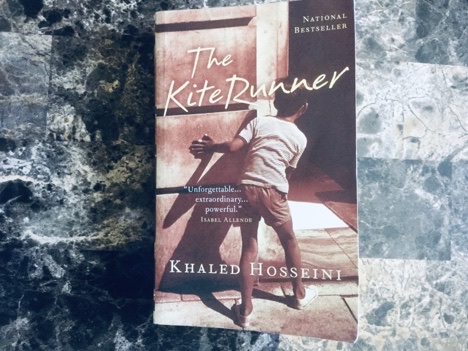
This debut novel, written by an Afghani expat physician living in the U.S., before the Americans and their allies imposed their own version of hell-on-earth on Afghanistan, has aged well. The multilayered culture of pre-war Afghanistan is hardly idyllic as family bonds are strained by dark secrets and betrayals. But it seems almost heavenly compared to the incredible cruelty imposed on the natives by the Soviet invaders and later by the Taliban. The narrator, the privileged son of a wealthy Kabul businessman, develops a strong boyhood bond with the son of his servant, is haunted by guilt after secretly betraying his friend and tries desperately to make amends for his cowardice for the rest of his life.
The graphic description of the cruelty of the Soviets and particularly the Taliban, is a jolting reminder of how political and religious dogma can be used for evil purposes, but there is no overall condemnation of any political or religious belief system. Some of the uniquely Muslim phrases and sayings may seem peculiar to westerners, but really are integral to the story.
The plot is complex with many unanticipated twists and turns. Small details introduced early, like a boy with a harelip, the game panipat, and a child with deadly skill with a slingshot, seem insignificant, but much later are reintroduced and become integral to the story. The psychopath who assaulted his childhood friend shows up much later as an incredibly cruel Taliban enforcer to terrorize and maim the narrator. There are several other equal symmetries like this that ingeniously tie the narrative together.
Several memorable quotes show great insight into universal human truths.
“ Children aren’t coloring books. You don’t get to fill them with your favorite colors.”
“…time can be a greedy thing- sometimes it steals all the details for itself.”
This is a great introduction to a culture and way of life that is completely foreign to me. I will never again be able to look at the Afghani or Pakistani (am I stereotyping?) clerk in the convenience store without wondering about what he or she has endured before coming to Canada
Thanks, Vera
*************************************************************
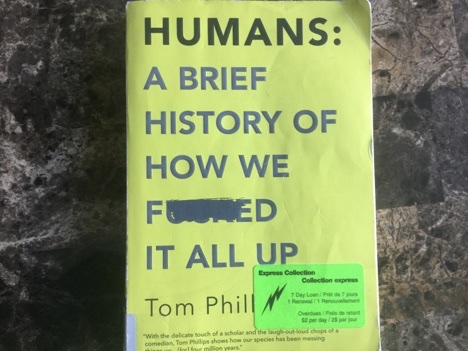
First a few random thoughts about language. The F word has ceased to have much, if any, of its original sexual connotation, and in the last few years has even ceased to carry the same shock value it once conveyed. Now, in popular usage, it seems to express disappointment, exasperation, despair, disapproval, alarm, or condemnation whether used as a verb, adjective, adverb or as a simple exclamation. But to me it still reveals some degree of vulgarity on the part of the speaker or writer. So I questioned why the author could not have titled this witty volume with something like How We Fouled It All Up, or How We Screwed It All Up. Perhaps in order to emphasize how badly, consistently, and dangerously we have collectively goofed, there is no adequate alternative wording that conveys the enormity of our collective stupidity. Like ‘screwed’, ‘fucked’ is changing its meaning as the English language evolves. What will replace these words to express shock and vulgarity in the coming years?
This writer, with dry humour British has a knack for seeing the absurd and the tragic aspects of some of the most bizarre but consequential decisions made in the history of our species. With far-ranging narrative mixed with biting sarcasm, he disparages the invention of war around 14,000 years ago, the introduction of rabbits and cane toads to Australia and starlings to New York, the bad decisions leading up to the mid-30s American Dust Bowl, and addition of lead to gasoline in the last century. In between, he cites numerous examples of many other very bad decisions by politicians, inventors, scientists and civic leaders. Some of these decisions seemed brilliant at the time and only became tragic when unintended consequences ensued. Others were so patently stupid from the start that one could only conclude that many of the influential leaders were absolutely bonkers, (King Farouk of Egypt was a kleptomaniac who stole Sir Winston Churchill’s pocket watch) and many of them, such as several of the Sultans of the Ottoman Empire were clearly insane; others by modern criteria would be considered psychopaths.
While Phillips touches on the neural and evolutionary reasons why we have f…ed up so regularly, in the first chapter, a more in-depth but less entertaining treatment of this is provided in Joseph T. Hallinan’s Why We Make Mistakes.
My favourite example of stupidity from this book is the explanation of why Guam became a U.S. territory. When the U.S. navy arrived there in 1898, months into the Spanish-American War, the Spanish government had neglected to tell any of their countrymen in Guam that they were at war with the U.S., so the island’s military brass sailed out to thank the U.S. sailors for their thirteen gun salute and immediately became prisoners of war.
There is a sober message in this book, but the anecdotes also provide great trivia that you could use anytime there is an awkward lull in the conversation that you feel obliged to fill at a dinner party – just don’t mention King Christian VII’s obsession.
A good light read.

 The Passionate Reader
I loved The Kite Runner. Mr. Hosseini writes beautifully and as you commented, I learned a lot about Afghanistan pre-wars. The second book sounds intriguing though I suspect anyone who keeps up with world news probably knew a lot of what is written. Post Trump would probably fill another 300 pages!
By the way I hope you are getting money for the ads on your blog.
LikeLike