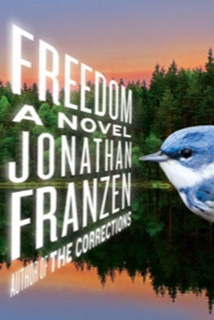
This novel, set largely in Minnesota, New York City, Washington D.C. and West Virginia in the 1980s to 2008 is populated by insecure, amoral, largely young characters with shifting loyalties and mental illnesses. They are from very dysfunctional families; no one could be considered normal. The dialogue of the characters is filled with extreme, constantly shifting expressions of love and hate.
Divided into eight unnumbered chapters, the narrative is broken up by time shifts. One hundred and sixty pages of what is said to be an autobiography, but is not written in the first person singular tense, reads more like a multi-character novel within the novel, covering several years of Patti Berglund’s life from college to married motherhood.
Walter Berglund’s long sermons about loss of biodiversity, climate warming, deforestation, population growth, food security, toxic wastes, feral outdoor bird-killing cats, etc, are all loosely tied to what was in 2010 politically fashionable even as he works as a government lobbyist after moving from Minnesota to D.C. There are many pages devoted to his efforts to preserve the endangered cerulean warbler and similar endangered species, but he also lobbies to obtain permits for coal companies to make fourteen thousand acres of Appalachian mountaintops in West Virginia into barren moonscape, destroying an entire thriving ecosystem. He justifies these contradictory actions with rants about the dangers of relying on nuclear power and wind farms. Some of his arguments are counterintuitive but quite compelling; others are quite specious. I suspect that they reflect the known somewhat radical views of the environmentalist author. Later efforts with Walter’s new lover to be address overpopulation (after his wife’s longstanding affair with his best friend, a young member of her son’s rock band, is discovered) run afoul of American right wing concepts of personal freedoms and rights.
Franzen is a master at mocking the absurd contradictions of American cultural and societal trends, driven by political correctness. The plot is quite intricate, but it is not very difficult to keep the characters straight, even with all of their contradictions. The emotional ups and downs ascribed to some characters do seem a bit excessive. The late reunion of Walter and Patti Berglund after a long separation is a bit of a surprise, but the fate of some other characters is left to the reader’s imagination.
The author seems obsessed with casual sex with seemingly no regard for any longterm consequences, and uses the most disgusting, vivid, foulest, scatological language in describing such trysts that I have ever read. None of the characters are faithful to their spouses. The gutter language is not confined to the conversations of the characters a reader could expect it from, but is an integral component of the author’s narrative. This unnecessary pervasive feature of the whole book compelled me to downgrade my assessment of it by three stars out of ten.
⭐️⭐️⭐️⭐️⭐️/10.
Thanks, Andra.
Cam
If you won two free plane tickets, where would you go?
Somewhere in Australia, the only continent that I haven’t visited
Some masochistic member of our book club has listed this for our upcoming meeting. Formatted as the fictitious autobiography of a coming-of-age British boy, this humongous classic by England’s most famous novelist of the 19th century has been reissued in a variety of updates. I read the 1869 edition as an ebook, wasting a good chunk of my limited reading time. In the early pages, it loosely reflects the experiences of the author as an orphaned child raised by an ever-changing variety of relatives in several southern England sites.
Filled with more truly evil characters than any reader could possibly keep track of, his early childhood is saturated with uncertainty and pathos. The extreme emotions describing his teen and early 20s all-consuming infatuations with girls are described in flowery language that goes on for many pages with too many exclamation marks. His abusive experiences in boy’s schools introduces him to a variety of those evil boys, most notably Uriah Heep, whose name has endured as the embodiment of unscrupulous cunning, greed and deceit. He would certainly fulfill the modern DSM-5 criteria for a diagnosis of psychopathic personality disorder. One of his school chums turns out to be an equally unscrupulous opportunist who secretly elopes to continental Europe with the betrothed bride-to-be of another youth.
His adult life is characterized by many ups and downs with numerous unexplained deaths and betrayals, but ultimately a happy family life as he becomes a famous and well off novelist like the author.
Obtuse language in very long winded conversations with many emotion-laden superlatives and exclamation marks are used to describe all of the characters. The narrative/conversation balance is severely tilted toward conversation. Run on sentences filling half a page abound and no characters say what they mean in straight forward language. The multitude of characters are as hard to keep straight as those in War and Peace.
The best quote that also expresses what I most dislike about the whole book is the author’s own observation that: “We like to talk about the tyranny of words, but we also like to tyrannize over them too; we are fond of having a large superfluous establishment of words to wait upon us on great occasions; we like to think it sounds important and sounds well. As we are not particular about the meaning of our liveries on state occasions, if they be but fine and numerous enough, so, the meaning or necessity of our words is of secondary consideration, if there be but a great parade of them.” This is just a small portion of a much longer dissertation about communication.
Lots of Dickens’ misogyny shows through, but little of his well-known racism is expressed here, although there are a few negative comments about East Indians.
There is no mention of sexual intercourse whatsoever, as befits the prudish Victorian era, let alone any sexual improprieties, but just a faint hint that two female characters may have had a brief secret lesbian relationship. (I may have read too much into their love for one another, as there is a lot of kissing and hugging, seemingly as expressions of fondness irrespective of the gender of the pairs and a lot males also express their love for one another in superlative language.)
I quite enjoyed reading A Tale of Two Cities, and Oliver Twist years ago although they too are overly wordy, but I cannot recommend this one for anyone.
⭐️/10
What foods would you like to make?
I struggle with any cooking, but I have made a good imitation of mother’s delicious sour cream raisin pie with meringue topping, and the Mississippi mud pie that she loved when I took her for lunch from the nursing home to the Crossroads restaurant in Elmira.
Which activities make you lose track of time?
Fly fishing in a quiet stream for trout or salmon, with flies that I tied.
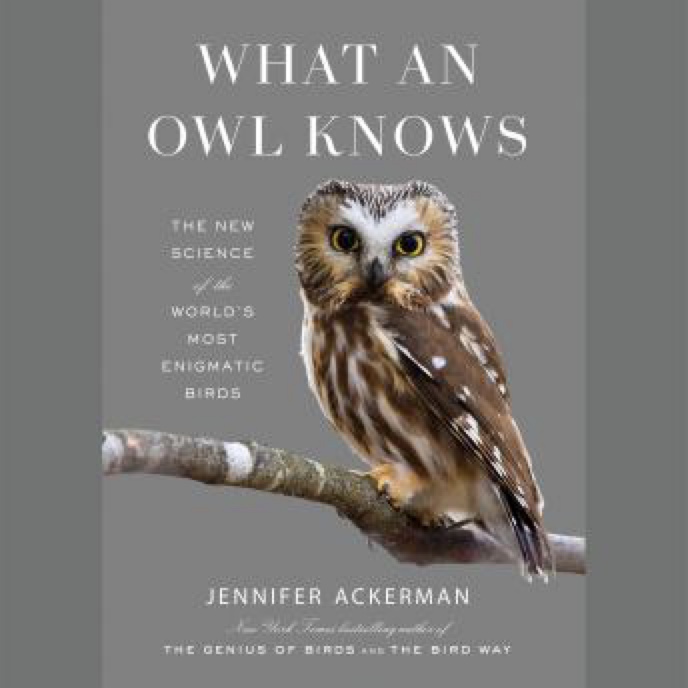
From the author of the engaging and informative 2016 “The Genius of Birds” comes another delightful discourse on a single amazingly talented and diverse order of avian life.
First, my personal encounter with an owl. One spring day as kids, my brother and I discovered a huge nest high in a beech tree; we climbed an adjacent tree to peer into it. A startled young great horned owlet fluttered to the ground apparently unharmed, but not yet able to fly. (According to Ackerman, great horned owls do not build tree nests, so this must have been a hawk or turkey vulture nest commandeered by the owl family.) We wrapped her in a coat and took her home, housing her in a chicken coop in the attic of the farm shed. We discovered that she didn’t care for fish, but liked to bite our fingers, so we wore leather gloves when feeding her. Thus we inadvertently joined such luminaries as Florence Nightingale, Theodore Roosevelt and Pablo Picasso in raising a pet owl although ours was never friendly and we only had her for one summer. We fed “Hooty” all kinds of game that we hunted, from groundhogs, rabbits, and squirrels to various birds. The excrement and regurgitated pellets of fur, feathers and bones created a lasting stench, permeating our clothes. As she grew to a wingspan of almost six feet, a size that only females grow to, we took her out for progressive flying lessons from increasing heights, returning her to the coop when she fluttered to the ground at further and further distances. When we took her to the peak of the barn roof one day for her lesson, she simply took off silently over the horizon. I doubt that she survived long in the wild without the hunting skills her parents would have taught her. According to Ackerman, great horned owlets spend six months learning hunting skills from their parents after fledgling before striking out on their own. So began my lasting fascination with, and love of, owls.
Some of the observations in this book are esoteric in the extreme. Marjon Savelberg, a classical musician who studies owl vocalizations claims that she can look at sheet music and hear the song and can, by seeing the spectrograms of owl vocalizations, hear the distinctive calls of individual birds. This seems like an acquired form of warped synesthesia, but many owl species also have the ability to “see” and locate prey from sound input into their relatively massive asymmetrical ears, using not just echolocation, but echo 3-D reconstruction of an image. And now, using terabytes of data and AI, Savelberg can correlate the recordings of individual owl’s vocalizations with their observed behaviour. Place neurones in the hippocampi of owls give them a durable mental map of the territory they fly over. Some owl species make Peyton Place look virtuous with unfaithful longterm mates and constant mate swapping while some adopt unrelated orphaned owlets in what looks like owl altruism; others sometimes abandon their own offspring.
Some of the narrative gives anthropomorphic attribution of human emotion to the birds, such as the grieving sounds of owls who lost their tree nests to a forest fire. But there is little doubt that owls, perhaps more than most birds, are endowed with a rich emotional repertoire, from anger, jealousy, and fear to elation, love, and grief. And there is no doubt that owls and some other birds use deductive reasoning to ‘read’ the minds, intentions, motivations, and emotions of friends and foes alike, a theory of mind that was once thought to be unique to mammals, and particularly humans. It seems that almost no mental or physical feat is unique to humans, except perhaps the purposeful use of fire and communication via written languages.
There is documentation here of a far greater variety of owls than I was was previously aware of, from the sparrow-sized Elf Owl on up to the Great Horned. The small Saw-whet owls are ubiquitous in North America, but seldom seen, as they are extremely well camouflaged to blend into their environment. I can’t recall having ever seen one, but I have on several occasions seen a murderous murder of crows loudly harassing and attacking an almost invisible sleepy owl during the daytime.
This book is almost as revealing about the huge number of owl keepers, Owl Preservation Societies, and owl researchers as it is about the birds. From mythical Athena’s Little Owl to Harry Potter’s pet Snowy Owl, Hedwig, owls have played an important part in human mythology and several religions. Some modern workers aim to rehabilitate injured birds, others train and raise infant owls who have imprinted on humans to become ambassadors to educate school children and the general public about these unique creatures. Such education is important to conserve owls. During the Hindu annual Festival of Lights thousands of owls are killed in a misguided rite to bring good luck. “Hooty” never imprinted on us, being all antagonistic owl from the start to the end of our relationship.
Both the coloured and the black-and-white photographs of owls are just delightful additions to the narrative of this book. Missing these with their strange face discs and piercing eyes would be a significant drawback of listening to this as an audiobook although it is available in that format.
When I saw a review in The New Yorker, the title alone was enough to entice me to put a hold on this book at the Ottawa Public Library where it was still on order.
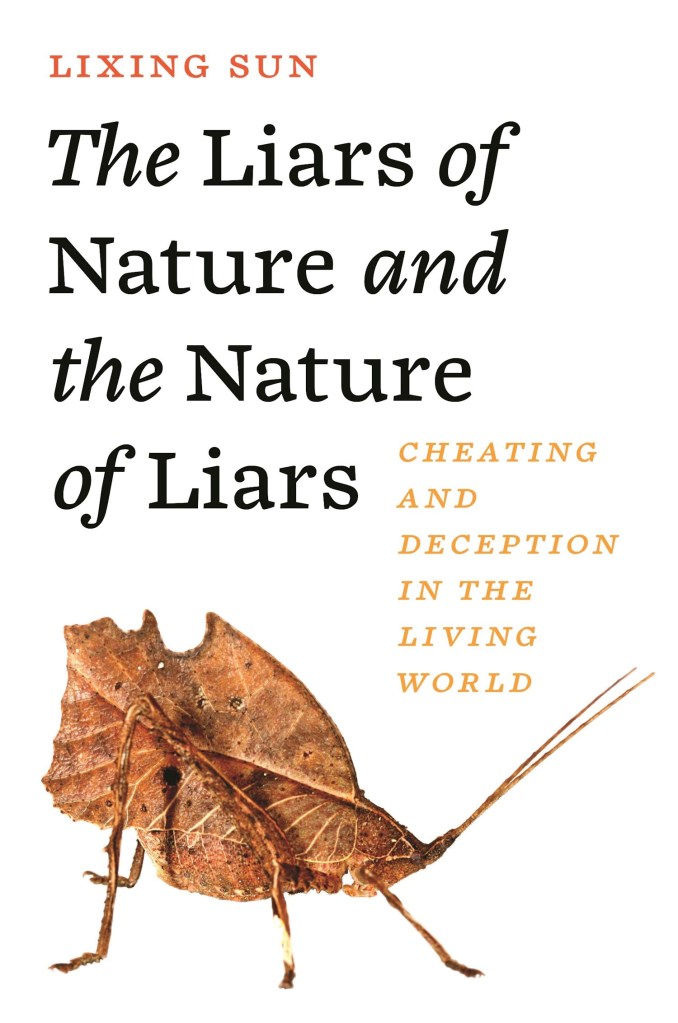
The China-born Distinguished Research Professor of Biology at Central Washington University provides an extensive scholarly discussion of the universality of lying and deception. Prevalent in the living world from lowly bacteria, viruses, and fungi that mutate to deceive hosts and and their siblings and thereby increase their propagation chances, to Homo sapiens, with a huge number of examples from the study of many species, lying and cheating seems to be universal. Most of the cited examples are erudite but interesting revelations about reptiles, birds and mammals and how they communicate both within species and across species lines. I now understand why some barn swallows I observed as a preteen seemed so protective of their nests and mates.
Two “Laws” of Lying i.e. falsifying honest messages in communication and exploiting other’s cognitive loopholes or blind spots which are biological foundations for lying and cheating respectively, are proposed, although I think the word “laws” would be better called “methods” or “types”
It takes either remarkable foolishness or an admirable dedication to scientific discovery to spend thirteen years studying the pheromones secreted from the anal glands of captive upstate New York beavers as the author did. But that showed that those pheromones were useful to the male beavers to identify kinships and avoid wasting resources on others, even if born to his allegedly monogamous mate.
The handicap hypothesis is applied to explain the existence of moose and deer antlers, peacock tails, and bright colours of male birds i.e an individual who can afford to show off such wasteful displays must be a potentially good mate. And the same handicap principle is applied to humans who signal fitness by, for example, giving nonreturnable expensive engagement rings of no other intrinsic value, or sporting expensive watches or cars, a la Thorsten Veblen.
Emmanuel Kant, and his categorical imperative to always, under all circumstances, tell the truth comes in for some criticism as Sun, in the final chapter waxes philosophical in distinguishing three types of lying and their moral implications, coming down on the side of consequentialist moral philosophers.
There is considerable overlap here with the content of David Livingston Smith’s 2004 book “Why We Lie” which I read years ago and many of the psychological phenomena, some old and some new to me are discussed to explain why we are easily deceived. But this is in the updated context of internet communication and especially AI which greatly facilitates the propagation of lies.
I have encountered my share of pathological liars and cheaters. The most memorable were a devout Anglican couple at whose hobby farm I spent many happy hours in the 1980s. The man was supposedly a foreign-trained pathologist until he was found not to be. Years later, he obtained a part-time job as a pathologist at a teaching hospital until a background check by the department head showed that he had had only one year of medical training.
A quibble: some of the black and white photographs are fuzzy and contribute little to the narrative.
⭐️⭐️⭐️⭐️⭐️⭐️⭐️⭐️/10
Thanks, The New Yorker.
What are you most worried about for the future?
Global warming, which will not effect me much but will impose major challenges to millions or billions of todays youth who will have to deal with rising sea levels, worsening droughts, floods and forest fires, and migration from areas of the world that become uninhabitable.
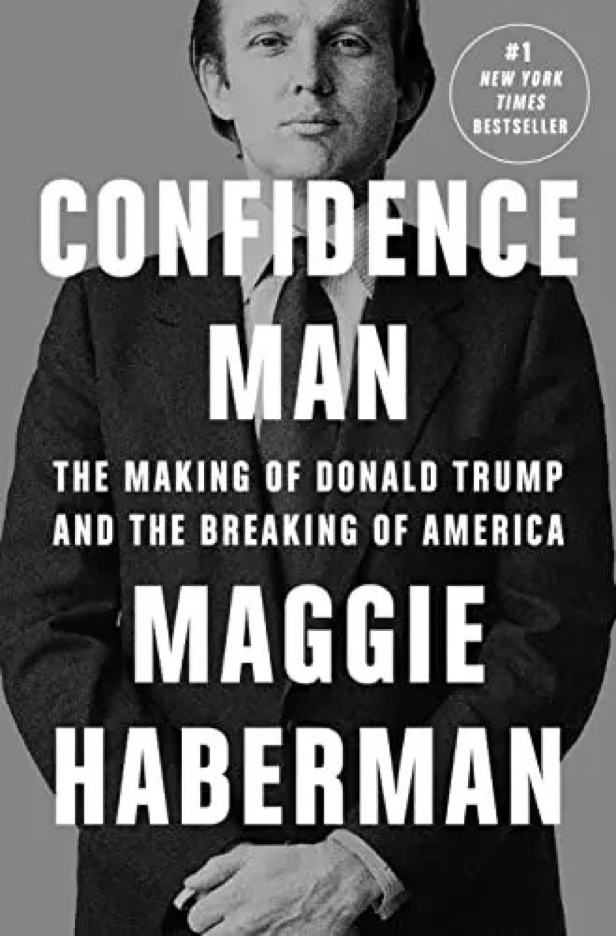
I was a little reluctant to post a review on my blog of this detailed Donald Trump biography by a longtime New York political journalist, fearful that it may feed into his egotistical hunger for any publicity, whether good or bad-and his litigious nature. However, a need to understand his appeal overcame that reluctance, and, given his aversion to reading, he is very unlikely to ever read or care about anything from a two-bit Canadian book reviewer.
From early childhood, learning from his father, he has always focused on personal wealth, power, and fame. There are more reasons to fear his actions detailed here than there are explanations of what is appealing to him for millions of Americans. His racism, sexual predations, misogyny, nepotism, and egotism are all laid out in detail, but much of that has been revealed before in the daily news, previous biographies and even by his own tweets, books, and statements. The constantly churning of hirings and firings in the Trump White House and the personal conflicts engendered there are emphasized. It seems to me that an analysis of what it is buried in the psyche of Americans that allows millions of his followers to overlook his obvious faults would be more interesting reading than this dry account of those faults.
This book is more revealing, in some ways, about the pervasive corrupt political and bureaucratic manoeuvring in the U.S. than about Trump. Powerful party bosses and leading politicians of all stripes with little interest in what is good for the average citizen wield enormous power is selecting candidates for various public offices.
In my opinion, a grievous omission from this tome is the lack of any mention of Trump’s capricious withdrawal of the U.S. from the multinational Paris Climate Accord, annoying many allied nations. That and Trump’s appointment of Scot Pruitt, a businessman and climate change denier, who had sued the Environmental Protection Agency forty one times, to head that agency has to have had disastrous negative effects on the climate we are all doomed to live in. Likewise, Haberman barely mentions Trump’s unilateral withdrawal from the multinational agreement with Iran to limit that country’s nuclear arms development and has thus made everyone’s world more dangerous.
I am still somewhat puzzled by Trump’s appeal even after struggling though this book.
⭐️⭐️⭐️⭐️⭐️⭐️/10
Thanks, The Economist, The New Yorker.
How important is spirituality in your life?
As the term is generally used, not at all. As it is used very loosely by some to indicate meaningful connections and deep awe of the mysteries of what we don’t know, it is quite important.
Following Jesus. Henri J. M. Nouwen. 2018. 132 pages. (Hardcover.)
To avoid getting stuck in a “thought silo” reading only books that share my basic outlook on life, I occasionally pick up one that I suspect before I start will be based on a premise that will not gel with mine. That was the case with this short treatise. Such endeavours to understand and appreciate the perspective of others cannot harm if one is secure in your own views. But in this one there was no underlying premise whatsoever.
It seems peculiar that this book based on six lectures by the author was first published in 2018, although the author died in 1996. The Dutch-borne itinerant, restless, American/Peruvian/Canadian Catholic priest could seemingly not enjoy working at Harvard Theological School for more than four months, returning to pastoral care, charities and writing.
C.S. Lewis, in his “The Problem of Pain” attempts to reconcile the existence an all powerful and all loving God with the universal cruelty, evil and pain of human and animal existence. This requires some fanciful linguistic definitions and gymnastic leaps of logic, but at least some attempts are made to argue rationally. Nouwen simply rejects logic as as valid starting point. Clearly rejecting logical thinking and favouring uninformed irrational actions, there is also an underlying current of anti-intellectualism.
Even in the lecture on the unconditional love of God, Nouwen uses selective quotes from the Bible, neglecting to mention the inconsistency of an all-loving God who urges us to forgive our enemies, while killing off people who don’t love him in a flood or the fires of hell or Sodom and Gomorrah, in a fit of jealous anger. I don’t know which translation of the Bible Nouwen is using, but some quotes, such as of the Beatitudes seem foreign to me.
“Following Jesus” as the title advocates, has been used as an excuse for the horrible cruelties in religious wars or lead to Jim Jones’ Jonestown or David Koresh’s Branch Davidians in Waco.
This book exceeded my expectations of providing an abundance of meaningless gobbledygook and linguistic licence such as “…there is no human being anywhere in the whole world who is not lifted up on the cross with Jesus.” or “What you need to hear with your heart…”
I persisted to the end hoping to find at least one quote worthy of some thought, but was disappointed even in that lowly quest. The best feature of this book is its brevity.
Lest I seem too down on all religions, I must confess to appreciating and even enjoying the works of some religious scholars. But Nouwen was no scholar, but a delusional brainwashed and probably lonely man
Part One of this ingenious plot is narrated in the first person singular by Rosie, a 17 year-old suddenly orphaned Sonoma County, California girl who, in 1938 is down on her luck. Her synesthesia (she sees certain sounds as different colours) is mistaken for hallucinations from psychosis and after a single drunken sexual encounter she is pregnant. The father of the child is not revealed to the reader until past page 100 and then is it is a shocking surprise. Sent to a locked home for unwed mothers, the insane, and psychopaths, she plots escape but is delivered of a baby who is immediately taken away from her. Several girls are forced to undergo secret salpingectomies to sterilize them at the peak of the entirely legal eugenics movement. She overhears that she is to be sterilized two days postpartum. I won’t spoil the suspense for the readers by revealing the subsequent turbulent and then very successful fulfilling, happy, married course of her life, but she becomes convinced, for a time, that her unusually severe synesthesia (she sees colours in response to names and places as well as to sounds) is a true disability that makes her unfit to reproduce.
A gift of an amaryllis bulb from the narrator of Part Two, which is discarded by her keepers, features prominently as it comes to aptly symbolize wasted years of her life because it fails to bloom annually, and Amaryllis is the name she requests the adoption agency to give her daughter.
Part Two is narrated by Helen, a single expat American relative of Rosie’s first keepers after she was orphaned. She works as a nannie in various European countries and is the one who gave her the amaryllis bulb. She flees from Nazi-controlled Vienna during the war to Lucerne smuggling disabled children across the border with her, and then she returns to a very different California to the one she left. In Vienna she had witnessed the Nazi eugenics sterilization of “undesirables” that preceded the mass extermination of them, and Jews in particular. Her life story is as complicated as that of Rosie’s but entirely different and, of course, their lives are interconnected.
I have long thought that both synesthesia and eugenics would be great features to build a novel around, and here it is, in imaginative, integrated, glorious detail. Synesthesia, present in 2-4 % of the population is still often confused with mental illness and psychosis in particular. Some synesthetics experience sounds as tastes or smells and some with mild forms of it do not even recognize it as unusual. Others hide it, viewing it as a disability. But it can also be seen as a partially genetically endowed artistic gift that boosts the imagination of artistic types, particularly writers. Readers may reasonably suspect that the author is endowed with it.
The eugenics movement that began in the 1910s and persisted until at least the 1960s is just a precursor to more radical Nazi-style policies about how to treat the unfortunate among us. The California’s eugenics laws were not repealed until 1979. In Canada, both Alberta and British Columbia had eugenics laws from the 1930s to the 1970s and some view modern fetal screening for genetic diseases and gene editing science as “positive eugenics.” Although now illegal it still informs the outlook of many racist politicians like Donald Trump.
I usually dislike time shift as an artificial literary device to maintain suspense in thrillers, but here it is used appropriately to maintain curiosity about the course of the lives of the two narrators. The other characters are numerous but unforgettable and not hard to keep straight. There is enough heartbreaking tragedy to make the most stoic reader blubber, but also wonderful life-affirming courage and determination to lift the spirits of the depressed. The dramatic ending is worth waiting for and although the general details of that ending are somewhat predicable, how the details unfold to get there are not.
One memorable quote: “People will always distrust what they don’t understand. And what they distrust they cannot love.”
I cannot praise this novel enough. Absolutely unforgettable and highly recommended.
⭐️⭐️⭐️⭐️⭐️⭐️⭐️⭐️⭐️⭐️
Thanks, Book Browse.
Beef tongue and sour cream raisin pie with meringue.
Which food, when you eat it, instantly transports you to childhood?
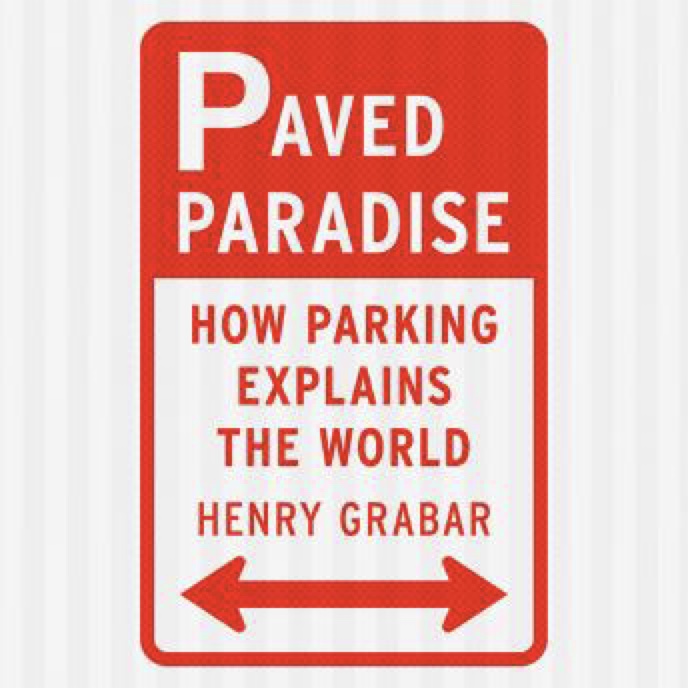
This screed was a loan from my real estate economist professor daughter who is visiting us this week. Often discussed as a source of frustration, parking is seldom the topic of an entire book but Grabar manages to make it interesting and informative. There is an entire history with major consequences for the way we live to accompany the paving over much of the world to “store” (the term Grabar prefers to “park.”) vehicles. The history is peppered with largely forgotten scandals. In 2009, Chicago mayor Richard Daley arranged a 75 year lease of all 36,000 of that city’s curb-side parking meters to Morgan Stanley, partly owned by the emirate of Dubai for $ 1.156 billion, although the value of them was independently estimated to be at least three times that amount. Organized crime syndicates were and still are major players in operating private parking lots in major U.S. cities. Many hours of productivity are lost, and millions of gallons of fuel are converted into atmospheric pollutants as people drive in loops looking for a place to park. Houston was devastated by Hurricane Harvey in 2017, in part or mainly because it had “ paved its way into an unmapped manmade floodplain” with little exposed topsoil to absorb the heavy rains and poorly anchored trees.o
Some progress is being made in certain areas where laws requiring a minimum number of parking spaces for new developments have been dropped, especially those close to adequate public transportation, but “By square footage, there is more housing for each car in the United States than there is for each person.”
I found some of the discussion of needed reforms a bit vague and confusing. ”Cars are a gateway drug to parking.” How can we be sure the relationship isn’t the inverse one – people use cars more where there is plentiful parking. But it is certainly true that “more parking means less housing, especially affordable housing “, the latter being my daughter’s topic for an address to the annual macroeconomics conference of the Bank of Canada as I write this.
One ancient foolish personal anecdote. In 1968, as a poor medical student, I required a car to get from one hospital to another in a timely fashion. But there was no place to park where I was boarding except on the sleepy dead end street, Wallace Avenue. The London inane bylaw prohibited street parking for any three consecutive hours between 12 a.m. and 7 a.m., which meant a patrol had to chalk mark the tires and curb and then return three or more hours later to stick a ticket on the windshield. I got a couple tickets every month, a bargain price for good parking. One night, studying late, I checked at 2 a.m. to find a ticket stating that I had parked from 12 a.m. to 3 a.m. I hopped into the car and handed the ticket to the sleepy clerk at the central police station at 2:30. He called the patrolman to reprimand him and tore up the ticket. Not a good move on my part. For the next month my tires were marked nightly, forcing me to take many nocturnal trips to the street to move the car.
First, a note about page numbers. I do not include the copyright page, contents list, index, references, notes, author information, or bibliography when I calculate the number of pages I cite in the title of these blogs. But whenever I can, I try to cite the number of pages in different formats, the time it took me to read an ebook or the listed time for an audiobook.
In this historical tome a New York journalist and academic historian provides what is really selective biographies of four past U.S. presidents. She claims they were chosen because she had studied them more than others but she also worked in the Johnson White House and later on his memoirs. To the reader, the choice of who to feature seems arbitrary, and I suspect there were other factors involved, such as their early loses (In Theodore Roosevelt’s case, his wife and his mother died on the same day as he was starting his political career.), the unprecedented crises they faced, and their early shared ambitions. In any case, here they are – Abraham Lincoln, Theodore Roosevelt, Franklin Roosevelt, and Lyndon Johnson.
The book is also divided logically into four parts- “Ambition and the Recognition of Leadership”, “Adversity and Growth”, The Leader and The Times: How they Led”, and a less concrete section titled “Transformational Leadership, “ largely on their respective legacies.
Theodore Roosevelt’s cagey solution to the 1902 coal strike was hardly on a par with Abe’s dealing with secessionists and civil war, nor FDR’s with the depression and WWII. Of 70 pages on the FDR presidency, all but two discuss his efforts with the new Deal,
There are scattered throughout the text dozens of trite directives, supposedly guides for potential leaders in any field, such as “ Find Time and Space in Which to Think,” and “Shield Colleagues from Blame” or “Know When To Hold Back, When To Move Forward.” Somehow I doubt that these will ever make it into a text for a course in developing leadership skills in any M.B.A. program.
I learned a huge amount about American history and the personalities of it’s leaders, from this very dry pedantic document, e.g. FDR was an auditory learner, Lincoln a visual one. This book provides more details of specific eras of U.S. politics than 99% of readers will want or ever need to know. There are other numerous biographies of every president and I am not sure how much of this one is based on original research. There are an unusual number of quotation marks and 178 pages of “Notes” that are really references, perhaps because the author was accused of plagiarism in relation to a previous book. (Her non-explanation was that she had neglected to use enough quotation marks.) There is almost no discussion of the rest of the world except as it relates to the U.S.A., and Canada is never even mentioned. I also learned little about the characteristics it takes to become a leader in any field.
⭐️⭐️⭐️⭐️⭐️/10
Thanks, Cal.
What’s the oldest thing you own that you still use daily?
My leather wallet that I made in shop class in high school.
Two Solitudes. Hugh MacLellan. 1945. (878 pages as Ebook, 480 as Paperback, 23 hours, 23 minutes as Audiobook))
This was, for me, a reread of a classic Canadian novel, written by a McGill professor of English, that I had first read perhaps 50 years ago. Set initially in a small village outside of Montreal in 1917, it spans the interwar years to September, 1939. The Two Solitudes of the title is usually interpreted as referring to the French Catholics and the English Protestants, but could equally refer to men and women, Americans and Canadians, the rich and the depression- era poor, or the exploited and the exploiters. Each fails to even try very hard to understand the other. Little has changed 83 years later.
The powerful controlling influence of the Catholic Church over every aspect of the lives of the quebecois is dramatically displayed, even in business deals, where they frequently clashed with the rich English Protestants from Ontario. (I recall an evangelical Baptist preacher in the late1950s condemning them from the pulpit, comparing them to despotic African dictators.) The 1917 conscription controversy and attitudes toward the war drove a deep wedge between the English Canadians and the francophone Quebeckers and even between members of families of the few Quebec French who supported it, including that of the federal MP Athanase Tallard. Some veterans provide dramatic descriptions of the horrors of Vimy Ridge and Passenchdaele.
The characters, clothing, geography, and weather are all described in intricate detail. There is no graphic sex, as befits the era, but lots of inuendo and expressions of lust. There are many delicious metaphors and pithy aphorisms like “Perhaps the basis of all conservatism was the tendency to identify the familiar with the excellent.”
Three other memorable quotations:
“His old face carried the expression of a man who never found it necessary to be intelligent but knew right from wrong.”
“What was love anyway but knowledge that you were not alone, with desire added?”
“His round head was balanced like a dome on his shoulders, his frizzy hair a horseshoe around his skull.”
I found that the endless rumination of characters about their lives, feelings, and strained relationships became a bit tiresome. The pages and pages of the conversations of a newlywed couple trying to outdo each other with ever more elaborate superlative praise for the other seemed quite soppy to me perhaps because in the family of my youth any public expression of affection or even more than mild praise was frowned upon.
This is only one of several books discussing the opioid crisis in the United States but is undoubtedly the most detailed with a laser focus on the Sackler family and their Perdue Pharma. The extensively researched documentation begins with Dr. Arthur Sackler Sr. in the 1930’s, 40’s and 50’s. A New York physician and researcher in psychiatry at an asylum, he was also an astute adman and entrepreneur, amassing a fortune, largely by making false claims for the value and safety of chlorpromazine (Thorazine), chlordiazepoxide (Librium), and diazepam (Valium) by his ad agency on behalf of Roche Pharmaceuticals. These were among the first drugs to be promoted directly to the public at large, with a focus for the latter two on anxious or depressed housewives. (“Mother’s little helper.”). He published a medical news magazine without being identified with it, promoting products that benefited him financially. He was also the first of the many Sackler’s to become a major philanthropist donating Chinese antique treasures to Columbia University and to museums, currying goodwill. He was sly, and secretive founding many corporations to hide his self-dealing and evade prosecution. Many more unflattering adjectives are applicable to him including dishonest, driven, egotistical, philandering, ruthless, scheming and misogynistic.
His now deceased sons, Arthur Jr., Mortimer, and Raymond, all doctors as well, are portrayed as equally evil with the development of the slow-release opioid pain-killers, MS Contin (morphine) and OxyContin (oxycodone). They knowingly marketed them aggressively to practitioners as non-addictive and lasting 12 hours, thereby avoiding the craving between doses. But their effects usually lasted only eight hours, inducing the craving that leads to abuse. With OxyContin that craving led many users to crush it to snort or inject and then switch to street heroin or fentanyl. When the patent was about to expire they reformulated it to extend the patent and beat out generic competitors and later secretly under the name Rhodes Pharmaceutical marketed their own generic oxycodone under the name RP-10 oxycodone. They deceived some regulators at the FDA, bribed others, and hired still others, in the well-known Washington revolving door phenomenon that includes politicians, businessmen, doctors, consultants, and most notably, lawyers. The more independent CDC has done more to alert the public about the opioid epidemic than has the FDA.
The next generation of Sacklers, lead by Richard, adamantly refused to acknowledge any blame for the opioid overdose epidemic that has killed more than one million Americans- until 2019, when they faced hundreds of lawsuits brought by the feds, states attorneys-generals, and the families of victims. They tried to blame the victims as morally weak, and play the victim role themselves-victims of a biased liberal media, comparing themselves to gun manufacturers, pointing out that guns do not kill people, people do. There is certainly a tendency for greedy, hypocritical, self-righteous libertarians to look down on addicts as morally inferior beings rather than as victims of a powerful system that prey on and benefit from their weakness.
The Sackler’s continued to enjoy high society esteem as generous philanthropists donating to at least 20 institutions and attaching their names to a whole wing of the Met, a library at Harvard and a medical school in Tel Aviv.
As revelations of the main source of their billions were uncovered, and lawsuits and legal fees mounted, a confusing mix of deals were agreed to. Charges against everyone except the Sackler’s were pursued, with state attorney’s-general often striking deals over the head of lead prosecutors. Finally in 2019 founding company Perdue Frederick, but not Perdue Pharma, was allowed to declare bankruptcy, but no Sackler was charged and they and Perdue Pharma escaped with many billion dollars. They continue selling OxyCodone through their Rhodes Pharmaceutical generic company and expanded their market of it internationally in 2015 with another company named MundiPharma, using the same dubious marketing strategy.
To be fair, Sackler doctors are not the only unscrupulous medics in this sordid business, as many others in so-called pill mills prescribe OxyContin on request and are rewarded by Sacklers who seldom report this obvious criminal activity. And other pharmaceuticals are far from blameless in this business. Jansen, a Johnson and Johnson subsidiary, expanded their 100,000 acre Tasmanian poppy operation to ensure a steady supply of opioids, as the market expanded. It seems that the Arthur Jr. wing of the Sackler dynasty has largely distanced itself from the opioid business and are feuding with the others. And most institutions have refused donations from them and removed their names from the donated wings. But they must have significant control over the internet information about their continuing sources of billions. There was nothing negative about Perdue in most search engine initial returns when I searched MundiPharma and Rhodes Pharmaceuticals.
During my days as a medical practitioner, I treated many narcotic addicts, but never prescribed OxyContin and, perhaps in error, like to think my prescription of narcotics was always appropriate. I did once have a prescription pad stolen from my office.
A simplified family tree of three generations of Sackler’s would have been a useful reference aid for readers like me who often have difficulty keeping characters straight.
This dismal documentary about wealth and greed is more detailed than most readers could possibly need or appreciate. A simplified account of these nefarious deeds is a part of the equally lengthy work in Gerald Posner’s book, Pharma.




 The Passionate Reader